SNORING
What type of snorer are you?
Knowing where your snoring comes from is the shortcut to the remedy that helps. Here's how to find out.
Why the type matters
Snoring is one sound with several sources. The soft palate, the uvula, the base of the tongue and the walls of the throat can all vibrate, and the nose and mouth change how hard you have to breathe 2. A nasal strip can't help a tongue that falls back, and a mouthguard can't clear a blocked nose. That is why one person swears by a remedy that does nothing for another.
| Type | Clues | Try first |
|---|---|---|
| Nose snoring | Worse with a cold or allergies; a stuffy nose at night; nostrils that close when you breathe in deeply | Clear the nose, nasal strips or dilators |
| Mouth snoring | A dry mouth in the morning; you snore with your mouth open | Clear the nose first, then keep the mouth closed with care: mouth taping |
| Tongue snoring | Worse on your back; a small or set-back lower jaw | Side sleeping, an anti-snore mouthguard, a tongue-retaining device |
| Palate snoring | A deep, fluttering, rattling sound, even with the mouth closed | Throat exercises, less alcohol, weight loss |
| Position snoring | Snoring mostly or only on your back | Side sleeping, anti-snore pillows |
| Lifestyle snoring | Louder after alcohol, sleeping pills or a very tiring day | Change the trigger and test it |
Simple tests to try at home
These are quick, informal checks that many snoring specialists describe to patients. They aren't validated tests and can't replace an examination, but they are a sensible place to start.
Four quick checks
- The nose test. Close your mouth and press one nostril shut. Breathe in through the other one. If the open nostril tends to collapse, or breathing is hard, your nose may be part of the problem. Try it on the other side.
- The mouth test. Open your mouth and make a snoring sound. Now close it and try again. If you can only snore with your mouth open, you may be a mouth snorer.
- The tongue test. Stick your tongue out as far as it comfortably goes, hold it gently between your teeth and try to snore. If the sound is much quieter, your tongue may be falling back when you sleep.
- The position test. Notice, or ask your partner, whether you snore mostly on your back. Better still, tag a week of nights with your position and compare.
When it's a mix
Many people snore from more than one place: a stuffy nose that leads to mouth breathing, or a back sleeper whose snoring is also louder after wine. Start with the remedy that matches your strongest clue, give it a week, then add the next. The remedy finder asks five questions and suggests an order.
How do I know what type of snorer I am?
Look for clues: snoring mostly on your back, a dry mouth in the morning, worse snoring with a cold. Simple at-home tests help, and tracking your nights with different tags shows which factors matter for you.
Is it worse to snore through the mouth or the nose?
Neither is worse in itself, but they call for different remedies. Mouth snoring often starts with a blocked nose, so clearing the nose comes first.
Can you snore with your mouth closed?
Yes. Snoring from the soft palate or the tongue can happen with the mouth closed 2.
Sources
- Nakano H, Ikeda T, Hayashi M, Ohshima E, Onizuka A. Effects of body position on snoring in apneic and nonapneic snorers. Sleep. 2003;26(2):169-172. doi.org/10.1093/sleep/26.2.169
- Pevernagie D, Aarts RM, De Meyer M. The acoustics of snoring. Sleep Med Rev. 2010;14(2):131-144. doi.org/10.1016/j.smrv.2009.06.002
- Ramar K, Dort LC, Katz SG, et al. Clinical practice guideline for the treatment of obstructive sleep apnea and snoring with oral appliance therapy: an update for 2015. J Clin Sleep Med. 2015;11(7):773-827. doi.org/10.5664/jcsm.4858
- Young T, Finn L, Kim H. Nasal obstruction as a risk factor for sleep-disordered breathing. J Allergy Clin Immunol. 1997;99(2):S757-S762. doi.org/10.1016/S0091-6749(97)70124-6
- Dort L, Brant R. A randomized, controlled, crossover study of a noncustomized tongue retaining device for sleep disordered breathing. Sleep Breath. 2008;12(4):369-373. doi.org/10.1007/s11325-008-0187-5
COMING SOON
Snore less.
Find what works.
Snores measures your snoring every night, suggests which remedies to try, guides a few minutes of throat exercises a day and shows which changes go with quieter nights for you. The sound stays on your iPhone.
Meet Snores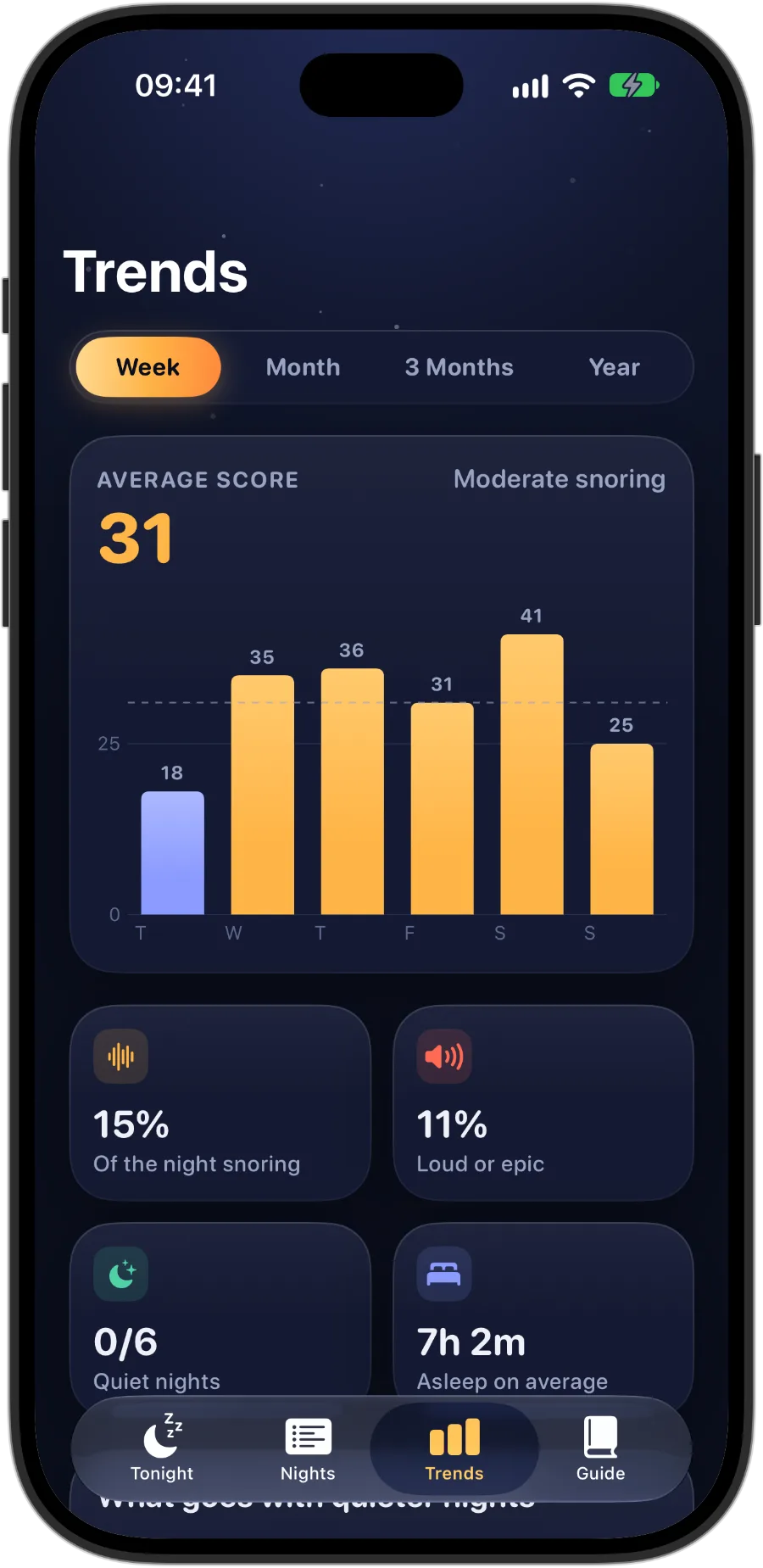
This page is general information, not medical advice. Snores is not a medical device and does not diagnose sleep apnea or any other condition. If you are worried about your sleep or your breathing, talk to a doctor.