REMEDIES
How to test a snoring remedy
One quiet night proves little. Here is a simple, fair way to find out what really helps you.
Why one night isn't enough
Snoring depends on your position, sleep stage, nose, evening and more, and all of those change from night to night 1. If you try nasal strips on a night when you happen to sleep on your side and skipped your usual glass of wine, a quiet night may have nothing to do with the strips.
The method
Six steps
- Measure your baseline. Record at least five normal nights to know your usual level of snoring.
- Change one thing at a time. If you try side sleeping and nasal strips together, you won't know which helped.
- Give it enough nights. About a week for most remedies, two weeks for a new mouthguard, and several weeks for exercises or weight loss.
- Record what else happened. Alcohol, a cold, a late meal, a very tiring day. These can swamp the effect of a remedy.
- Compare averages, not single nights. Look at the average of the nights with the remedy against the nights without it.
- Keep what works, drop what doesn't. Then test the next thing.
What to measure
- How much you snore: the share of the night spent snoring.
- How loudly: loud snoring disturbs partners more, and louder snoring goes with more breathing disturbances 2.
- How you feel: whether you wake refreshed.
- Your partner's view, if you share a room.
How long should I try a snoring remedy?
About a week for most remedies, two weeks for a new mouthguard, and around three months for exercises or weight loss.
How do I know if a snoring remedy is working?
Compare the average of several nights with it to several nights without it. A partner's view and how you feel in the morning help too.
Can I try more than one remedy at once?
You can, but you won't know which one helped. Once you've found what works, combining remedies is fine.
Why does my snoring change every night?
Position, sleep stage, a blocked nose, alcohol and tiredness all vary from night to night 1.
Sources
- Pevernagie D, Aarts RM, De Meyer M. The acoustics of snoring. Sleep Med Rev. 2010;14(2):131-144. doi.org/10.1016/j.smrv.2009.06.002
- Wilson K, Stoohs RA, Mulrooney TF, et al. The snoring spectrum: acoustic assessment of snoring sound intensity in 1,139 individuals undergoing polysomnography. Chest. 1999;115(3):762-770. doi.org/10.1378/chest.115.3.762
- Camacho M, Robertson M, Abdullatif J, et al. Smartphone apps for snoring. J Laryngol Otol. 2015;129(10):974-979. doi.org/10.1017/S0022215115001978
COMING SOON
Find out
how you snore.
Snores listens through the night on your iPhone and shows you in the morning how much and how loudly you snored, with clips of the loudest moments. Tag what you tried and see what goes with quieter nights. The sound stays on your iPhone.
Meet Snores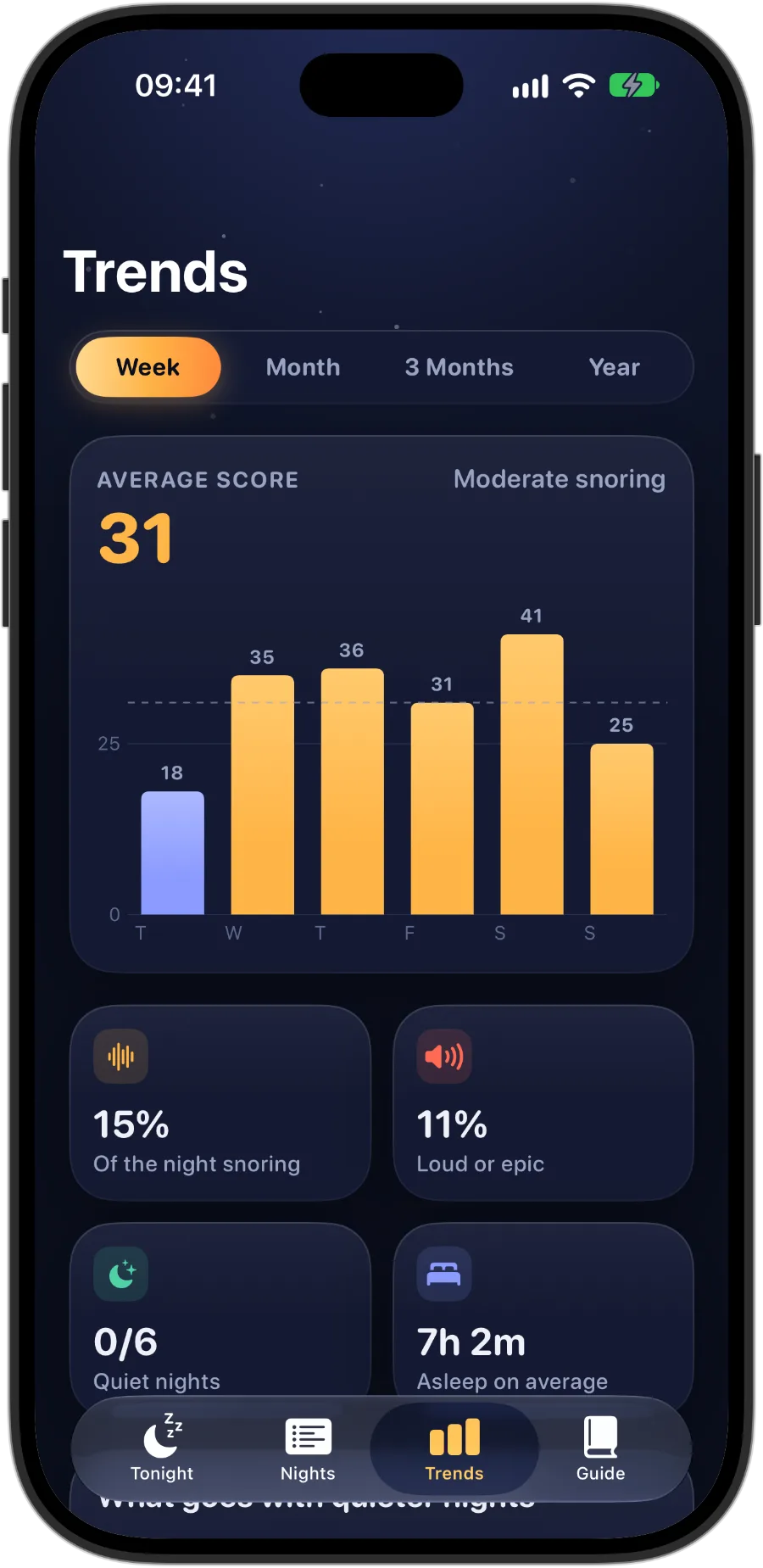
This page is general information, not medical advice. Snores is not a medical device and does not diagnose sleep apnea or any other condition. If you are worried about your sleep or your breathing, talk to a doctor.