FREE TOOL
Snoring remedy finder
Five questions about how you sleep. Up to three remedies to test, most promising first.
How it works
The finder uses the same rules as “What to try first” in the Snores app. Each answer points to the remedies that target that cause: side sleeping for back sleepers 1, the nose first when it is blocked 2, less evening alcohol for regular drinkers 3. Exercises and a mouthguard fill in for everyone, because they help many snorers but take longer 4,5. Ties go to the simpler, cheaper thing to try.
Mouth tape is only suggested when your nose is clear, you don't drink alcohol most evenings and nobody has noticed pauses in your breathing, because that is when it is reasonable to try 6. A “yes” to the last question puts “talk to a doctor first” at the top.
Once you have your suggestions, test them one at a time.
Which snoring remedy should I try first?
It depends on why you snore. Back sleepers often do best with side sleeping, people with a blocked nose with clearing it, and evening drinkers with less alcohol.
Is the remedy finder a medical test?
No. It suggests remedies to test based on your answers. It can't diagnose anything.
Are my answers saved?
No. They stay in this page and aren't sent anywhere.
Sources
- Nakano H, Ikeda T, Hayashi M, Ohshima E, Onizuka A. Effects of body position on snoring in apneic and nonapneic snorers. Sleep. 2003;26(2):169-172. doi.org/10.1093/sleep/26.2.169
- Young T, Finn L, Kim H. Nasal obstruction as a risk factor for sleep-disordered breathing. J Allergy Clin Immunol. 1997;99(2):S757-S762. doi.org/10.1016/S0091-6749(97)70124-6
- Issa FG, Sullivan CE. Alcohol, snoring and sleep apnea. J Neurol Neurosurg Psychiatry. 1982;45(4):353-359. doi.org/10.1136/jnnp.45.4.353
- Ieto V, Kayamori F, Montes MI, et al. Effects of oropharyngeal exercises on snoring: a randomized trial. Chest. 2015;148(3):683-691. doi.org/10.1378/chest.14-2953
- Ramar K, Dort LC, Katz SG, et al. Clinical practice guideline for the treatment of obstructive sleep apnea and snoring with oral appliance therapy: an update for 2015. J Clin Sleep Med. 2015;11(7):773-827. doi.org/10.5664/jcsm.4858
- Rhee J, Iansavitchene A, Mannala S, Graham ME, Rotenberg B. Breaking social media fads and uncovering the safety and efficacy of mouth taping in patients with mouth breathing, sleep disordered breathing, or obstructive sleep apnea: a systematic review. PLoS One. 2025;20(5):e0323643. doi.org/10.1371/journal.pone.0323643
COMING SOON
Find out
how you snore.
Snores listens through the night on your iPhone and shows you in the morning how much and how loudly you snored, with clips of the loudest moments. Tag what you tried and see what goes with quieter nights. The sound stays on your iPhone.
Meet Snores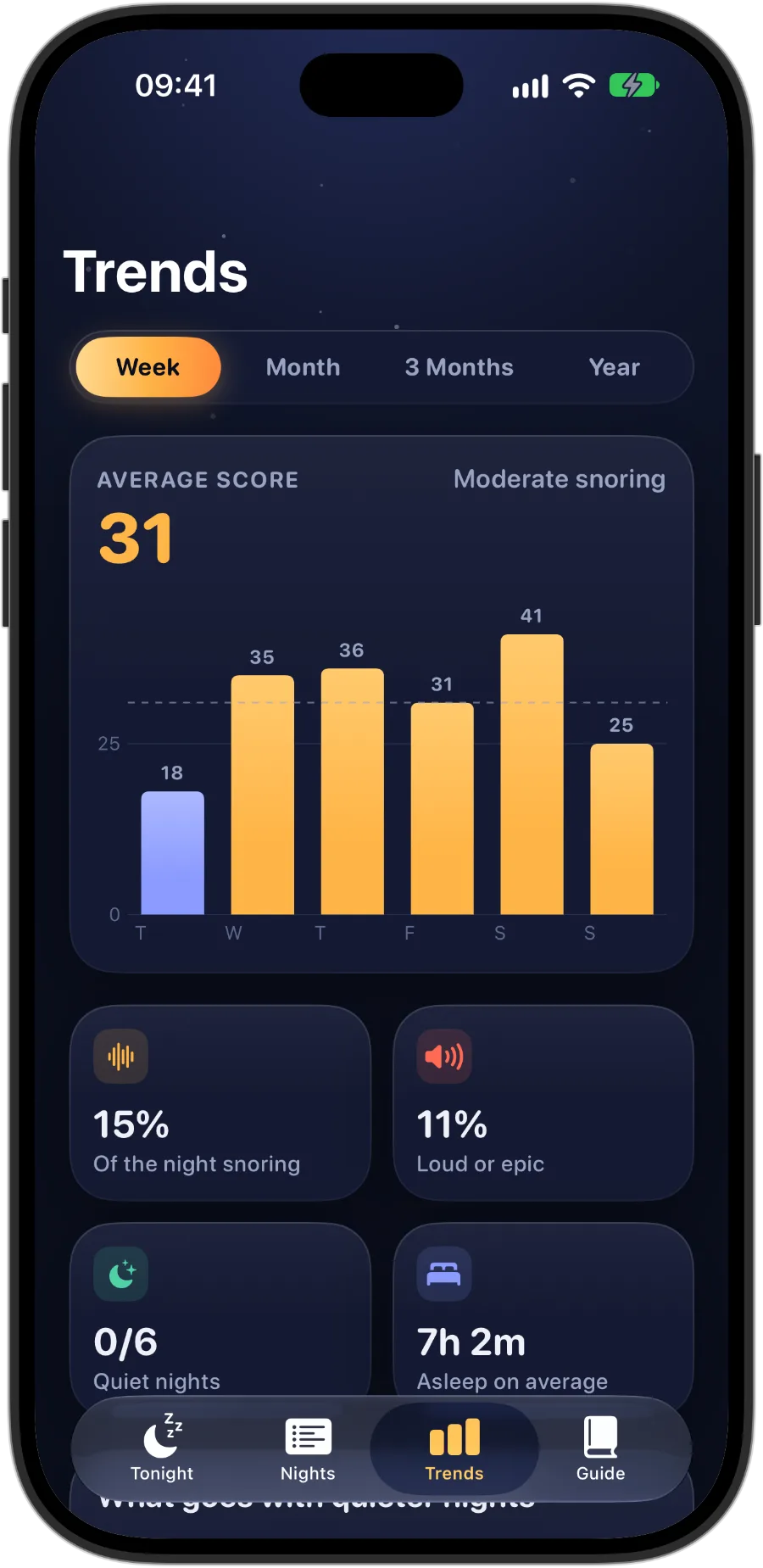
This page is general information, not medical advice. Snores is not a medical device and does not diagnose sleep apnea or any other condition. If you are worried about your sleep or your breathing, talk to a doctor.