REMEDIES
How to stop snoring
A step-by-step plan, from what you can try tonight to what needs a dentist or doctor.
Step 1: what you can try tonight
Tonight
- Sleep on your side. Most people without sleep apnea snore less on their side 2. A pillow behind your back or a body pillow helps. See side sleeping.
- Skip alcohol in the last few hours before bed. Alcohol relaxes the throat and can turn snoring into breathing pauses 3. See snoring and alcohol.
- Clear your nose. If your nose is blocked, try a saline rinse or a nasal strip. See a blocked nose and allergies.
- Raise the head of your bed a little if you can't stay off your back. See raising the head of the bed.
Step 2: what takes a few weeks
Over weeks
- Mouth and throat exercises for a few minutes every day. In a randomized trial, three months of daily exercises roughly halved the number of snores per hour 4. See mouth and throat exercises.
- Lose weight if you carry extra. A 10% weight loss went with a 26% fall in sleep apnea severity 5. See snoring and weight.
- Stop smoking. Current smokers are more likely to snore than people who never smoked, and former smokers aren't 6. See does smoking cause snoring?.
- Treat allergies. Night-time nasal symptoms go with habitual snoring 7, and nasal steroid sprays can ease congestion 8.
Step 3: with a dentist or doctor
With help
- An anti-snore mouthguard. Sleep medicine guidelines recommend oral appliances for adults who want treatment for snoring without sleep apnea 9. Ones fitted by a dentist work best. See anti-snore mouthguards.
- A sleep study, if simple remedies don't help or you have warning signs 1.
- Medical treatments such as CPAP for sleep apnea, or surgery in selected cases. See medical treatments.
What doesn't help much
Some popular fixes have little evidence. A chin strap on its own didn't reduce snoring in people with sleep apnea 10. Nasal strips improve nasal breathing but didn't reduce snoring in people with sleep apnea 11. Mouth tape has only small, uncontrolled studies and real risks for some people 12. They may still help some simple snorers, which is why it is worth testing, carefully.
How to tell what's working
Snoring varies a lot from night to night on its own 13, so one quiet night after trying something new proves little. Track a few normal nights first, then try one remedy at a time for about a week, and compare. Testing a remedy explains how.
What is the fastest way to stop snoring?
For many people, sleeping on their side and skipping alcohol before bed make a difference the same night. If your nose is blocked, clearing it can help quickly too.
Can snoring be cured?
Often it can be reduced a lot, and sometimes it stops completely, but it depends on the cause. Remedies that target your own cause work best.
Sources
- Kapur VK, Auckley DH, Chowdhuri S, et al. Clinical practice guideline for diagnostic testing for adult obstructive sleep apnea: an American Academy of Sleep Medicine clinical practice guideline. J Clin Sleep Med. 2017;13(3):479-504. doi.org/10.5664/jcsm.6506
- Nakano H, Ikeda T, Hayashi M, Ohshima E, Onizuka A. Effects of body position on snoring in apneic and nonapneic snorers. Sleep. 2003;26(2):169-172. doi.org/10.1093/sleep/26.2.169
- Issa FG, Sullivan CE. Alcohol, snoring and sleep apnea. J Neurol Neurosurg Psychiatry. 1982;45(4):353-359. doi.org/10.1136/jnnp.45.4.353
- Ieto V, Kayamori F, Montes MI, et al. Effects of oropharyngeal exercises on snoring: a randomized trial. Chest. 2015;148(3):683-691. doi.org/10.1378/chest.14-2953
- Peppard PE, Young T, Palta M, Dempsey J, Skatrud J. Longitudinal study of moderate weight change and sleep-disordered breathing. JAMA. 2000;284(23):3015-3021. doi.org/10.1001/jama.284.23.3015
- Wetter DW, Young TB, Bidwell TR, Badr MS, Palta M. Smoking as a risk factor for sleep-disordered breathing. Arch Intern Med. 1994;154(19):2219-2224. doi.org/10.1001/archinte.1994.00420190121014
- Young T, Finn L, Kim H. Nasal obstruction as a risk factor for sleep-disordered breathing. J Allergy Clin Immunol. 1997;99(2):S757-S762. doi.org/10.1016/S0091-6749(97)70124-6
- Craig TJ, Teets S, Lehman EB, Chinchilli VM, Zwillich C. Nasal congestion secondary to allergic rhinitis as a cause of sleep disturbance and daytime fatigue and the response to topical nasal corticosteroids. J Allergy Clin Immunol. 1998;101(5):633-637. doi.org/10.1016/S0091-6749(98)70171-X
- Ramar K, Dort LC, Katz SG, et al. Clinical practice guideline for the treatment of obstructive sleep apnea and snoring with oral appliance therapy: an update for 2015. J Clin Sleep Med. 2015;11(7):773-827. doi.org/10.5664/jcsm.4858
- Bhat S, Gushway-Henry N, Polos PG, et al. The efficacy of a chinstrap in treating sleep disordered breathing and snoring. J Clin Sleep Med. 2014;10(8):887-892. doi.org/10.5664/jcsm.3962
- Camacho M, Malu OO, Kram YA, et al. Nasal dilators (Breathe Right strips and NoZovent) for snoring and OSA: a systematic review and meta-analysis. Pulm Med. 2016;2016:4841310. doi.org/10.1155/2016/4841310
- Rhee J, Iansavitchene A, Mannala S, Graham ME, Rotenberg B. Breaking social media fads and uncovering the safety and efficacy of mouth taping in patients with mouth breathing, sleep disordered breathing, or obstructive sleep apnea: a systematic review. PLoS One. 2025;20(5):e0323643. doi.org/10.1371/journal.pone.0323643
- Pevernagie D, Aarts RM, De Meyer M. The acoustics of snoring. Sleep Med Rev. 2010;14(2):131-144. doi.org/10.1016/j.smrv.2009.06.002
- Main C, Liu Z, Welch K, Weiner G, Jones SQ, Stein K. Surgical procedures and non-surgical devices for the management of non-apnoeic snoring: a systematic review of clinical effects and associated treatment costs. Health Technol Assess. 2009;13(3):1-208. doi.org/10.3310/hta13030
COMING SOON
Find out
how you snore.
Snores listens through the night on your iPhone and shows you in the morning how much and how loudly you snored, with clips of the loudest moments. Tag what you tried and see what goes with quieter nights. The sound stays on your iPhone.
Meet Snores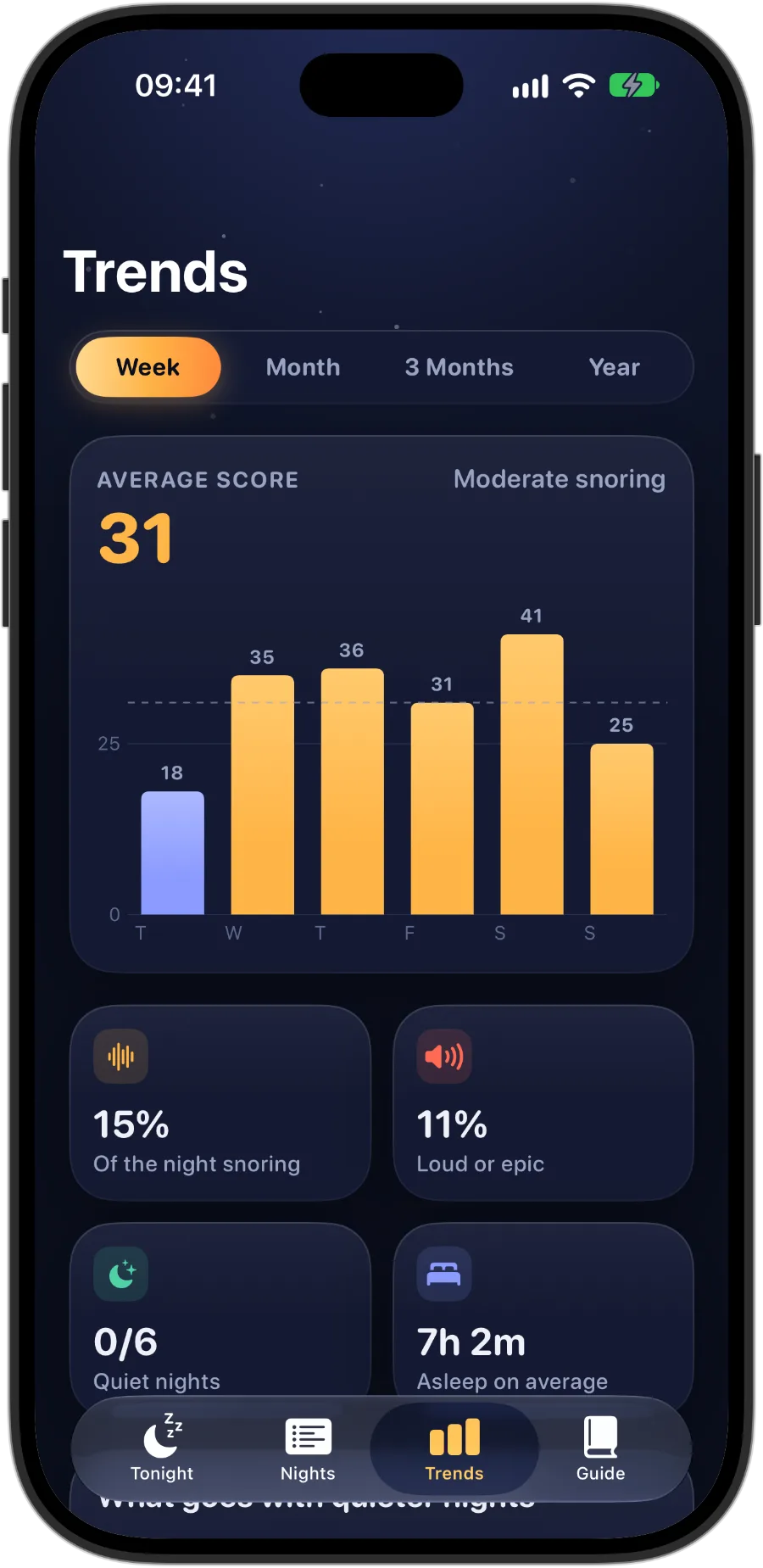
This page is general information, not medical advice. Snores is not a medical device and does not diagnose sleep apnea or any other condition. If you are worried about your sleep or your breathing, talk to a doctor.