SNORING
Snoring and weight
How weight narrows the airway, and how much a modest change can quiet it.
Why weight matters
Fat isn't only stored around the waist. It also builds up in the tongue, the soft palate and the walls of the throat, and around the neck. All of it leaves less room for air and makes the airway easier to collapse when the throat muscles relax in sleep. Extra weight around the belly also reduces the volume of the lungs, which makes the airway floppier.
That is why obesity is one of the strongest risk factors for snoring and sleep apnea 3,4, and why a thicker neck goes with more sleep apnea 5.
Key study
Weight change and sleep apnea over four years
- 690 adults
- Wisconsin, USA
- Measured twice, 4 years apart
Adults from the general population had their breathing measured in a sleep lab twice, four years apart. Compared with people whose weight stayed stable, a 10% weight gain predicted a 32% increase in the apnea-hypopnea index, and a 10% weight loss a 26% decrease. A 10% gain also made moderate to severe sleep apnea six times more likely.
What happens to snoring when you lose weight
Weight loss has mostly been studied for sleep apnea, but some studies measured snoring directly. In one, 19 men who snored heavily took part in a six-month weight-loss program. The nine who lost 3 kg or more cut their snores per hour from 320 to 176. Three who lost an average of 7.6 kg almost stopped snoring. Men who gained weight snored no less 2.
In a Finnish trial with 72 overweight adults with mild sleep apnea, a supervised very-low-calorie diet with lifestyle counselling led to an average loss of about 11 kg. A year later, the people in the program were far less likely to still have sleep apnea than those who had routine advice, and their symptoms, snoring among them, had improved 6.
Making it work
Practical steps
- Aim for a modest, steady change. A 10% weight loss was enough for a clear effect in the Wisconsin study 1.
- Combine it with quick wins. Side sleeping and less evening alcohol work from the first night while weight loss takes months.
- Watch the trend, not the night. Changes in snoring from weight loss build slowly, over weeks and months.
- Ask for help from a doctor or dietitian, especially if you have sleep apnea.
Will losing weight stop my snoring?
It often reduces it, and for some people it stops it, but not for everyone. In one small study, the men who lost the most weight almost stopped snoring 2.
How much weight do I need to lose to stop snoring?
There is no fixed amount. In studies, a 10% change in weight made a clear difference to sleep apnea 1, and even 3 kg reduced snoring in heavy snorers 2.
Why did I start snoring after gaining weight?
Extra weight around the neck and in the throat narrows the airway. Weight gain predicts worse sleep-disordered breathing 1.
Do thin people snore?
Yes. Weight is only one cause. Jaw shape, a blocked nose, alcohol and sleeping on your back all play a part.
Sources
- Peppard PE, Young T, Palta M, Dempsey J, Skatrud J. Longitudinal study of moderate weight change and sleep-disordered breathing. JAMA. 2000;284(23):3015-3021. doi.org/10.1001/jama.284.23.3015
- Braver HM, Block AJ, Perri MG. Treatment for snoring: combined weight loss, sleeping on side, and nasal spray. Chest. 1995;107(5):1283-1288. doi.org/10.1378/chest.107.5.1283
- Ohayon MM, Guilleminault C, Priest RG, Caulet M. Snoring and breathing pauses during sleep: telephone interview survey of a United Kingdom population sample. BMJ. 1997;314(7084):860-863. doi.org/10.1136/bmj.314.7084.860
- Young T, Palta M, Dempsey J, Skatrud J, Weber S, Badr S. The occurrence of sleep-disordered breathing among middle-aged adults. N Engl J Med. 1993;328(17):1230-1235. doi.org/10.1056/NEJM199304293281704
- Young T, Shahar E, Nieto FJ, et al. Predictors of sleep-disordered breathing in community-dwelling adults: the Sleep Heart Health Study. Arch Intern Med. 2002;162(8):893-900. doi.org/10.1001/archinte.162.8.893
- Tuomilehto HP, Seppä JM, Partinen MM, et al. Lifestyle intervention with weight reduction: first-line treatment in mild obstructive sleep apnea. Am J Respir Crit Care Med. 2009;179(4):320-327. doi.org/10.1164/rccm.200805-669OC
COMING SOON
Find out
how you snore.
Snores listens through the night on your iPhone and shows you in the morning how much and how loudly you snored, with clips of the loudest moments. Tag what you tried and see what goes with quieter nights. The sound stays on your iPhone.
Meet Snores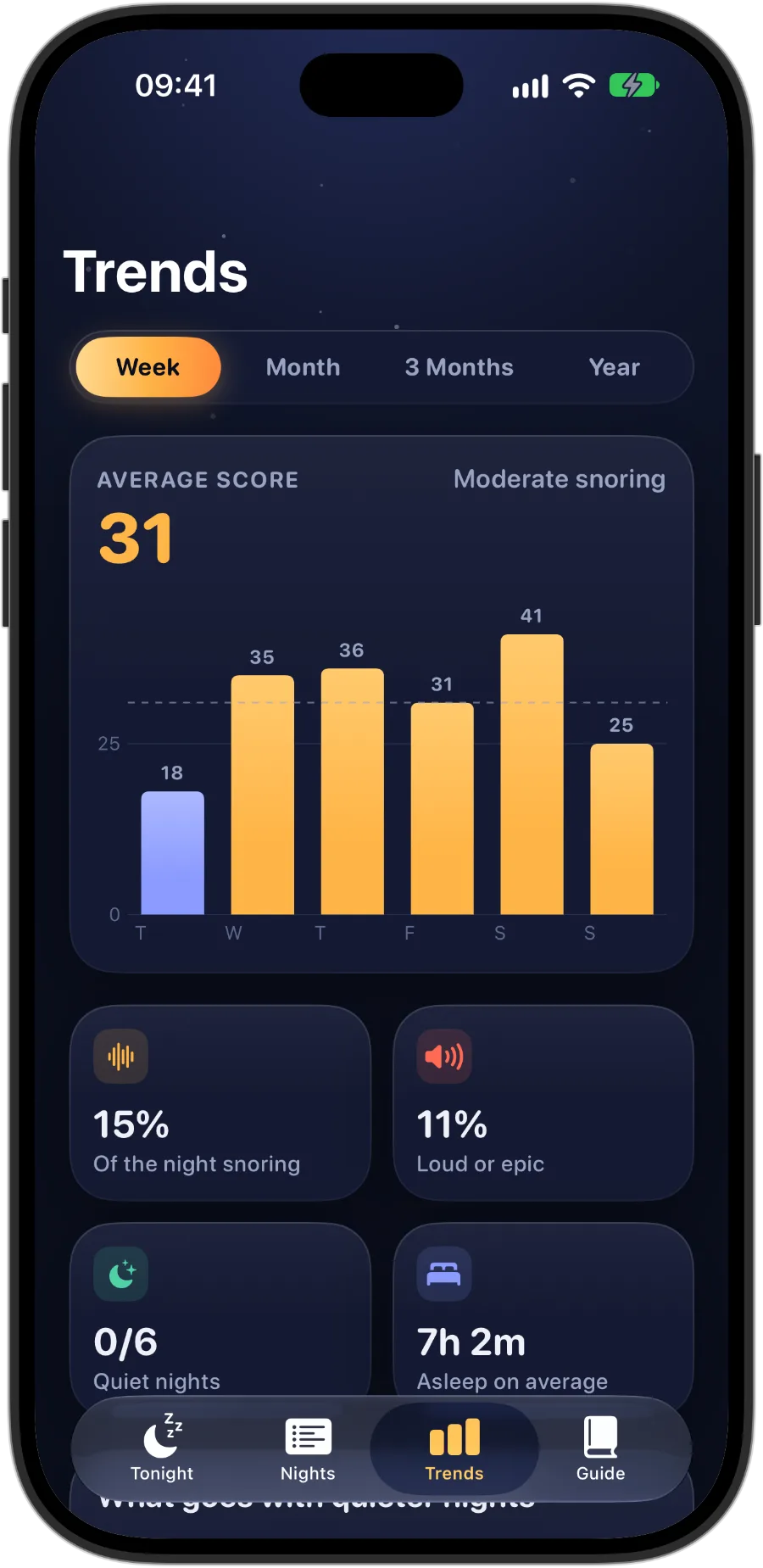
This page is general information, not medical advice. Snores is not a medical device and does not diagnose sleep apnea or any other condition. If you are worried about your sleep or your breathing, talk to a doctor.