THE APP
How Snores works
What happens between “Start tonight” and your morning summary, and what the numbers mean.
Snores is a snoring tracker for iPhone and iPad, made by Flawless Studio. You start it at bedtime, leave your iPhone on the nightstand, and in the morning it shows how much and how loudly you snored. This page explains how it measures that, as plainly as we can.
Listening, on your iPhone
Snores listens through the microphone and, every second, does two things. It measures how loud the room is. And it asks Apple's built-in sound classifier, which runs on your iPhone, how confident it is that the sound is snoring. Research systems have shown that sound alone can tell snoring from other noises very accurately 1.
A second counts as snoring when the classifier is confident and the sound rises at least 4 decibels above the room's own quiet level, its noise floor, measured over the last ten minutes. That makes Snores ignore steady sounds like a fan and adapt to every bedroom.
Light, loud and epic
How far snoring rises above the noise floor sets its intensity: light, loud from 14 decibels above it and epic from 24. Using the room as the reference keeps nights comparable even if the phone sits in a slightly different spot.
The Snore Score
Each second of snoring counts 1 point when light, 2 when loud and 3 when epic. The score adds them up for the time Snores listened and turns that into a number from 0 to 100. Under 10 is a quiet night, 10 to 24 light, 25 to 49 moderate, 50 to 74 loud and 75 and up epic. Try it in the Snore Score calculator.
Clips of the loudest moments
Snoring seconds close together form a snoring spell. Snores keeps 10 seconds of audio around the peak of each loud spell and, in the morning, the ten loudest: you see the three loudest for free and all ten with Pro. You can play, keep, name or share them, and mark one as not snoring, a partner or a fan, so the score leaves it out.
Breathing while snoring
Snoring has a rhythm: one snore per breath. From that rhythm, Snores estimates your breathing rate while snoring, and it notices long pauses between snores: 10 to 60 seconds of quiet right after steady snoring, followed by snoring again. It hears sound, not breathing, so it can't say why snoring paused, and it never diagnoses. Pauses in breathing are a reason to talk to a doctor 2.
Time in bed and time asleep
Snores estimates when you fell asleep and woke from the calm and activity it hears, or reads time asleep from Apple Health when another app or an Apple Watch recorded it.
Privacy
- Sound is analyzed on your iPhone. Audio never goes to a server, ours or anyone else's.
- Clips stay on your iPhone unless you share one, or turn on the optional iCloud backup of the recordings you keep (Pro, off by default), which saves them to your own private iCloud.
- Old clips are deleted after a week, a month or three months, as you choose, unless you keep them.
- Scores, timelines, tags and notes sync through your own private iCloud. There is no account, no ads and no tracking.
What Snores is not
Snores is not a medical device and is not a sleep test. It can't diagnose sleep apnea or any other condition, and a quiet score doesn't rule one out 3. If you're worried about your sleep, see snoring or sleep apnea? and talk to a doctor.
How does Snores detect snoring?
With Apple's built-in sound classifier, on your iPhone, combined with how far the sound rises above your room's quiet level.
Does Snores upload my audio?
No. Audio is analyzed on your iPhone and never sent to a server. It leaves your iPhone only if you share a clip or turn on the iCloud backup of kept recordings, to your own private iCloud.
Does Snores work on iPad?
Yes, Snores runs on iPhone and iPad with iOS 18 or later.
Can Snores tell if I have sleep apnea?
No. It measures sound and can point out long pauses between snores, but only a sleep study can diagnose sleep apnea 3.
Sources
- Dafna E, Tarasiuk A, Zigel Y. Automatic detection of whole night snoring events using non-contact microphone. PLoS One. 2013;8(12):e84139. doi.org/10.1371/journal.pone.0084139
- Young T, Shahar E, Nieto FJ, et al. Predictors of sleep-disordered breathing in community-dwelling adults: the Sleep Heart Health Study. Arch Intern Med. 2002;162(8):893-900. doi.org/10.1001/archinte.162.8.893
- Kapur VK, Auckley DH, Chowdhuri S, et al. Clinical practice guideline for diagnostic testing for adult obstructive sleep apnea: an American Academy of Sleep Medicine clinical practice guideline. J Clin Sleep Med. 2017;13(3):479-504. doi.org/10.5664/jcsm.6506
COMING SOON
Find out
how you snore.
Snores listens through the night on your iPhone and shows you in the morning how much and how loudly you snored, with clips of the loudest moments. Tag what you tried and see what goes with quieter nights. The sound stays on your iPhone.
Meet Snores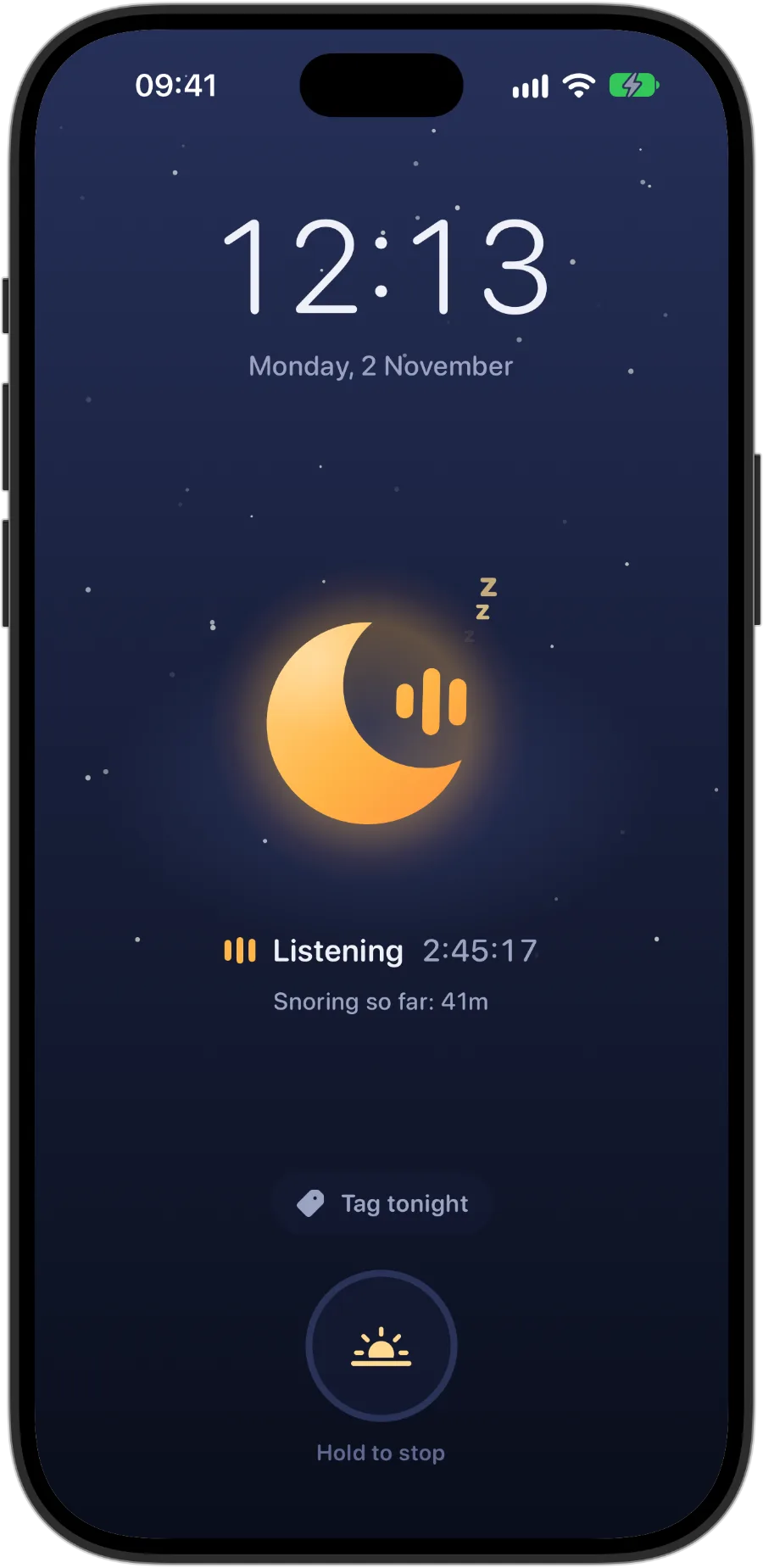
This page is general information, not medical advice. Snores is not a medical device and does not diagnose sleep apnea or any other condition. If you are worried about your sleep or your breathing, talk to a doctor.