SNORING
Snoring or sleep apnea?
Most snoring is harmless. Here are the signs that it may be sleep apnea, and what to do about them.
What happens in sleep apnea
In simple snoring, the airway narrows and vibrates, but air keeps flowing. In obstructive sleep apnea, it narrows so much that it collapses: breathing slows (a hypopnea) or stops (an apnea) for ten seconds or more, oxygen levels dip, and the brain briefly wakes you to reopen the airway. You usually don't remember these awakenings, but they can happen dozens of times an hour.
- Apnea
- A pause in breathing of 10 seconds or more during sleep.
- Hypopnea
- A partial reduction in breathing of 10 seconds or more, with a drop in oxygen or an awakening.
- AHI
- The apnea-hypopnea index: how many apneas and hypopneas happen per hour of sleep. 5 to 14 is mild, 15 to 29 moderate, and 30 or more severe.
- Sleep study
- A test that records breathing, oxygen and sleep overnight. Polysomnography is done in a sleep lab; a home sleep apnea test uses a smaller device in your own bed.
The signs to look out for
| Simple snoring | Possible sleep apnea | |
|---|---|---|
| Breathing | Steady snoring | Snoring that stops, then a gasp, snort or choke |
| Daytime | You feel fine | Very sleepy, nodding off without meaning to, poor concentration |
| Mornings | Maybe a dry mouth | Often headaches or feeling unrefreshed |
| Health | No related problems | Often high blood pressure; often extra weight around the neck |
In the Sleep Heart Health Study of 5,615 adults, people who reported habitual snoring, loud snoring and frequent breathing pauses were 3 to 4 times more likely to have moderate or worse sleep apnea. Being male, older, heavier and having a thicker neck also counted, though less 3. Loudness matters too: in more than 1,100 people tested in a sleep lab, louder snoring went with more breathing disturbances 5.
How common is sleep apnea?
More common than most people think. In a Wisconsin study of middle-aged workers, 24% of men and 9% of women had at least mild sleep-disordered breathing, and 4% of men and 2% of women had the full syndrome with daytime sleepiness 6. Later estimates for the United States put moderate to severe sleep-disordered breathing at 10% of men aged 30 to 49, 17% of men aged 50 to 70, 3% of women aged 30 to 49 and 9% of women aged 50 to 70 7. Worldwide, an analysis estimated that almost a billion adults aged 30 to 69 have at least mild obstructive sleep apnea 8.
Most of them don't know. In one study of almost 5,000 adults, researchers estimated that 93% of women and 82% of men with moderate to severe sleep apnea had never been diagnosed 4.
How it is diagnosed
The American Academy of Sleep Medicine recommends that sleep apnea be diagnosed with polysomnography or a home sleep apnea test, and not with questionnaires or prediction tools alone 1. A doctor will usually ask about your snoring, your sleepiness and your health, and then arrange a sleep study. A partner's description, or a few recordings of your snoring, can help explain what happens at night.
If sleep apnea is found, there are good treatments: a CPAP machine for many people, an oral appliance for mild to moderate cases, and sometimes surgery. See medical treatments.
Does snoring mean I have sleep apnea?
No. Most people who snore don't have sleep apnea: in one large survey 40% snored regularly but under 2% had the syndrome 2. Loud snoring with pauses, gasping or daytime sleepiness is the combination worth checking.
Can you have sleep apnea without snoring?
Yes, though it is less common. Some people with sleep apnea snore softly or not at all, which is one reason a sleep study, not the noise alone, is needed for a diagnosis 1.
Can a snoring app detect sleep apnea?
No. An app can record snoring and long gaps between snores, which may be worth showing a doctor, but diagnosing sleep apnea needs a sleep study 1.
Is sleep apnea dangerous?
Untreated severe sleep apnea is linked with heart attacks and strokes, and the sleepiness it causes raises the risk of accidents. Treatment lowers these risks 9. See is snoring bad for you?.
Sources
- Kapur VK, Auckley DH, Chowdhuri S, et al. Clinical practice guideline for diagnostic testing for adult obstructive sleep apnea: an American Academy of Sleep Medicine clinical practice guideline. J Clin Sleep Med. 2017;13(3):479-504. doi.org/10.5664/jcsm.6506
- Ohayon MM, Guilleminault C, Priest RG, Caulet M. Snoring and breathing pauses during sleep: telephone interview survey of a United Kingdom population sample. BMJ. 1997;314(7084):860-863. doi.org/10.1136/bmj.314.7084.860
- Young T, Shahar E, Nieto FJ, et al. Predictors of sleep-disordered breathing in community-dwelling adults: the Sleep Heart Health Study. Arch Intern Med. 2002;162(8):893-900. doi.org/10.1001/archinte.162.8.893
- Young T, Evans L, Finn L, Palta M. Estimation of the clinically diagnosed proportion of sleep apnea syndrome in middle-aged men and women. Sleep. 1997;20(9):705-706. doi.org/10.1093/sleep/20.9.705
- Wilson K, Stoohs RA, Mulrooney TF, et al. The snoring spectrum: acoustic assessment of snoring sound intensity in 1,139 individuals undergoing polysomnography. Chest. 1999;115(3):762-770. doi.org/10.1378/chest.115.3.762
- Young T, Palta M, Dempsey J, Skatrud J, Weber S, Badr S. The occurrence of sleep-disordered breathing among middle-aged adults. N Engl J Med. 1993;328(17):1230-1235. doi.org/10.1056/NEJM199304293281704
- Peppard PE, Young T, Barnet JH, et al. Increased prevalence of sleep-disordered breathing in adults. Am J Epidemiol. 2013;177(9):1006-1014. doi.org/10.1093/aje/kws342
- Benjafield AV, Ayas NT, Eastwood PR, et al. Estimation of the global prevalence and burden of obstructive sleep apnoea: a literature-based analysis. Lancet Respir Med. 2019;7(8):687-698. doi.org/10.1016/S2213-2600(19)30198-5
- Marin JM, Carrizo SJ, Vicente E, Agusti AG. Long-term cardiovascular outcomes in men with obstructive sleep apnoea-hypopnoea with or without treatment with continuous positive airway pressure: an observational study. Lancet. 2005;365(9464):1046-1053. doi.org/10.1016/S0140-6736(05)71141-7
COMING SOON
Find out
how you snore.
Snores listens through the night on your iPhone and shows you in the morning how much and how loudly you snored, with clips of the loudest moments. Tag what you tried and see what goes with quieter nights. The sound stays on your iPhone.
Meet Snores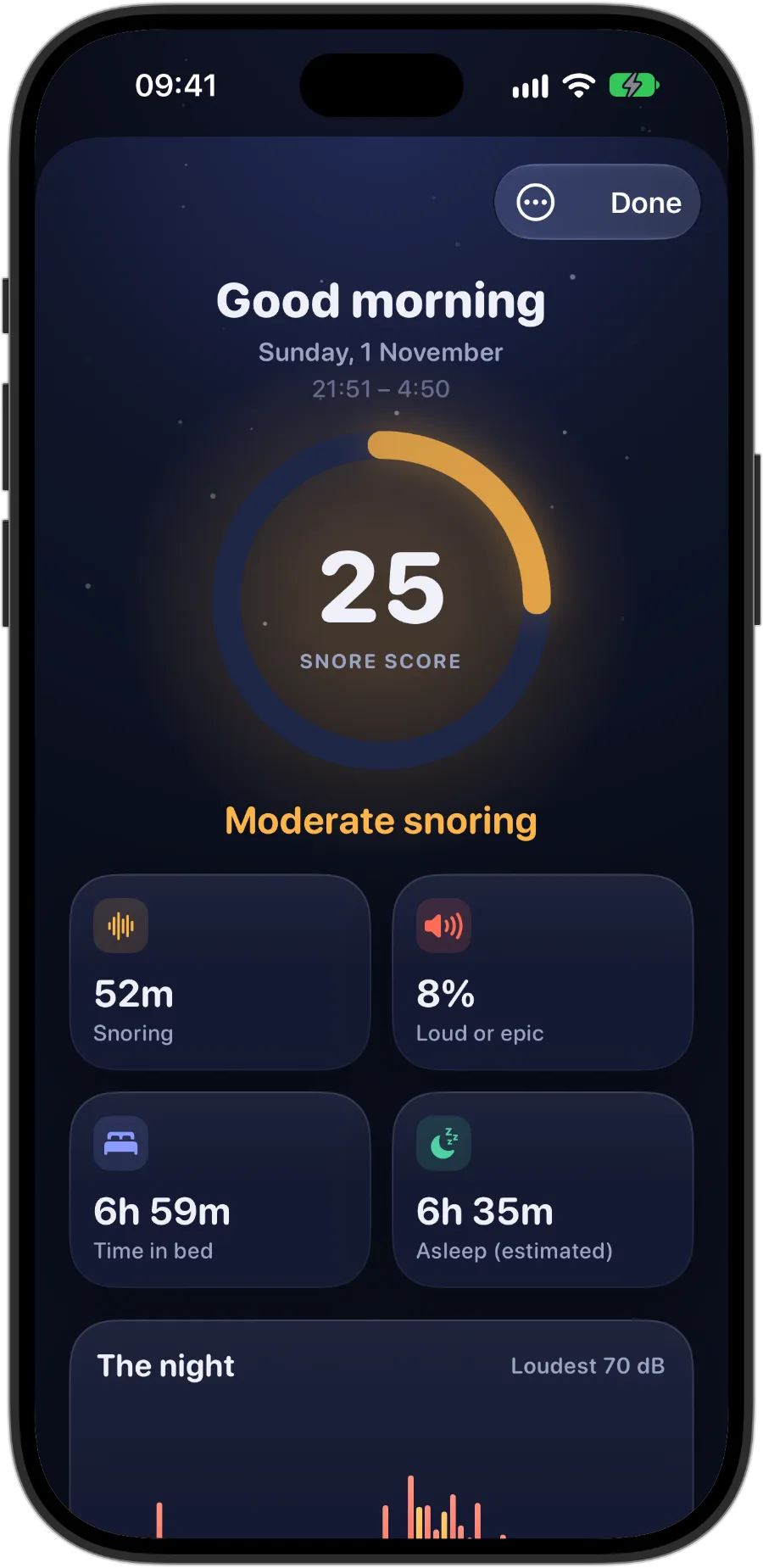
This page is general information, not medical advice. Snores is not a medical device and does not diagnose sleep apnea or any other condition. If you are worried about your sleep or your breathing, talk to a doctor.