
ANSWERS
Is it normal to snore every night?
Very common, often harmless, and worth a closer look in a few cases.
How common nightly snoring is
Regular snoring is reported by between a fifth and two fifths of adults, depending on the study and the definition 3. In the UK survey of 4,972 people, 40% said they snored regularly, while only 3.8% reported breathing pauses in their sleep 1.
When nightly snoring is worth checking
- someone notices you stop breathing, gasp or choke;
- you are very sleepy during the day, or nod off when you don't mean to;
- you wake with headaches or unrefreshed most mornings;
- you have high blood pressure;
- your snoring started recently or got much louder;
- a child snores on most nights.
If any of these apply, see snoring or sleep apnea? and talk to a doctor.
If it's just snoring
Nightly snoring without these signs is usually a nuisance rather than a health problem; a long-term study found no link between snoring itself and heart disease or stroke 4. But it can still disturb your partner and your own sleep, and the simple remedies often help. See how to stop snoring.
Is snoring every night bad?
Not necessarily. It is common and often harmless, but nightly loud snoring with pauses or daytime sleepiness should be checked 2.
Why do I snore every night all of a sudden?
Weight gain, a cold or allergies, alcohol, new medicines, pregnancy or menopause are common reasons. See why did I start snoring?.
Do most people snore?
Many do. Around 40% of adults in one large survey snored regularly 1.
Does everyone snore sometimes?
Most people snore occasionally, for example with a cold, after alcohol or when very tired.
Sources
- Ohayon MM, Guilleminault C, Priest RG, Caulet M. Snoring and breathing pauses during sleep: telephone interview survey of a United Kingdom population sample. BMJ. 1997;314(7084):860-863. doi.org/10.1136/bmj.314.7084.860
- Young T, Shahar E, Nieto FJ, et al. Predictors of sleep-disordered breathing in community-dwelling adults: the Sleep Heart Health Study. Arch Intern Med. 2002;162(8):893-900. doi.org/10.1001/archinte.162.8.893
- Pevernagie D, Aarts RM, De Meyer M. The acoustics of snoring. Sleep Med Rev. 2010;14(2):131-144. doi.org/10.1016/j.smrv.2009.06.002
- Marshall NS, Wong KK, Cullen SR, Knuiman MW, Grunstein RR. Snoring is not associated with all-cause mortality, incident cardiovascular disease, or stroke in the Busselton Health Study. Sleep. 2012;35(9):1235-1240. doi.org/10.5665/sleep.2076
COMING SOON
Find out
how you snore.
Snores listens through the night on your iPhone and shows you in the morning how much and how loudly you snored, with clips of the loudest moments. Tag what you tried and see what goes with quieter nights. The sound stays on your iPhone.
Meet Snores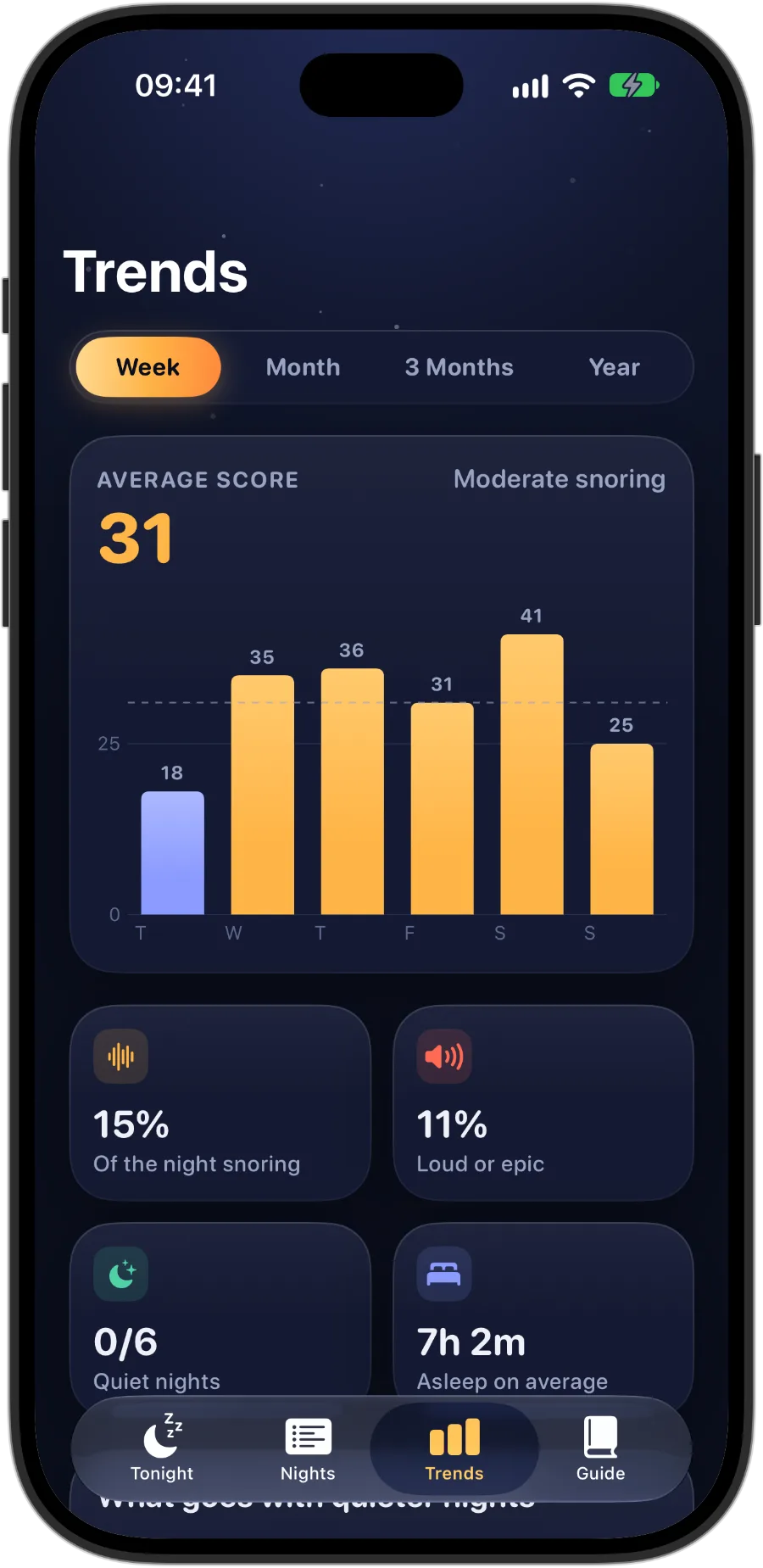
This page is general information, not medical advice. Snores is not a medical device and does not diagnose sleep apnea or any other condition. If you are worried about your sleep or your breathing, talk to a doctor.