ANSWERS
Why did I start snoring?
New snoring usually has a reason. Here are the common ones.
The common causes
| Cause | Why it matters |
|---|---|
| Weight gain | Fat around the neck and in the throat narrows the airway 1. See snoring and weight. |
| More alcohol | Relaxes the throat muscles 3. See snoring and alcohol. |
| A blocked nose | Colds, allergies, nasal polyps 4. See a blocked nose. |
| Getting older | The airway becomes more collapsible with age 5. See snoring and age. |
| Pregnancy or menopause | Hormones, weight and a stuffy nose 6,2. See snoring in women. |
| Smoking | Current smokers are more likely to snore 7. |
| New medicines | Sleeping pills, sedatives and some others relax the throat. Ask your doctor; don't stop them yourself. |
| Sleeping on your back | A new mattress, an injury or a new partner can change how you sleep 8. |
Why do I snore now when I never used to?
Weight gain, alcohol, a blocked nose, age, new medicines, pregnancy and menopause are the usual reasons.
Can stress make you snore?
Not directly, but stress can mean poorer sleep, more alcohol and being very tired, all of which can make snoring louder.
Can a new pillow or mattress make you snore?
Only if it changes how you sleep, for example more on your back, or bends your neck forward.
Can medication cause snoring?
Sleeping pills, sedatives and some other medicines relax the throat. Talk to your doctor before changing any medicine.
Sources
- Peppard PE, Young T, Palta M, Dempsey J, Skatrud J. Longitudinal study of moderate weight change and sleep-disordered breathing. JAMA. 2000;284(23):3015-3021. doi.org/10.1001/jama.284.23.3015
- Young T, Finn L, Austin D, Peterson A. Menopausal status and sleep-disordered breathing in the Wisconsin Sleep Cohort Study. Am J Respir Crit Care Med. 2003;167(9):1181-1185. doi.org/10.1164/rccm.200209-1055OC
- Issa FG, Sullivan CE. Alcohol, snoring and sleep apnea. J Neurol Neurosurg Psychiatry. 1982;45(4):353-359. doi.org/10.1136/jnnp.45.4.353
- Young T, Finn L, Kim H. Nasal obstruction as a risk factor for sleep-disordered breathing. J Allergy Clin Immunol. 1997;99(2):S757-S762. doi.org/10.1016/S0091-6749(97)70124-6
- Eikermann M, Jordan AS, Chamberlin NL, et al. The influence of aging on pharyngeal collapsibility during sleep. Chest. 2007;131(6):1702-1709. doi.org/10.1378/chest.06-2653
- Pien GW, Pack AI, Jackson N, et al. Risk factors for sleep-disordered breathing in pregnancy. Thorax. 2014;69(4):371-377. doi.org/10.1136/thoraxjnl-2012-202718
- Wetter DW, Young TB, Bidwell TR, Badr MS, Palta M. Smoking as a risk factor for sleep-disordered breathing. Arch Intern Med. 1994;154(19):2219-2224. doi.org/10.1001/archinte.1994.00420190121014
- Nakano H, Ikeda T, Hayashi M, Ohshima E, Onizuka A. Effects of body position on snoring in apneic and nonapneic snorers. Sleep. 2003;26(2):169-172. doi.org/10.1093/sleep/26.2.169
COMING SOON
Find out
how you snore.
Snores listens through the night on your iPhone and shows you in the morning how much and how loudly you snored, with clips of the loudest moments. Tag what you tried and see what goes with quieter nights. The sound stays on your iPhone.
Meet Snores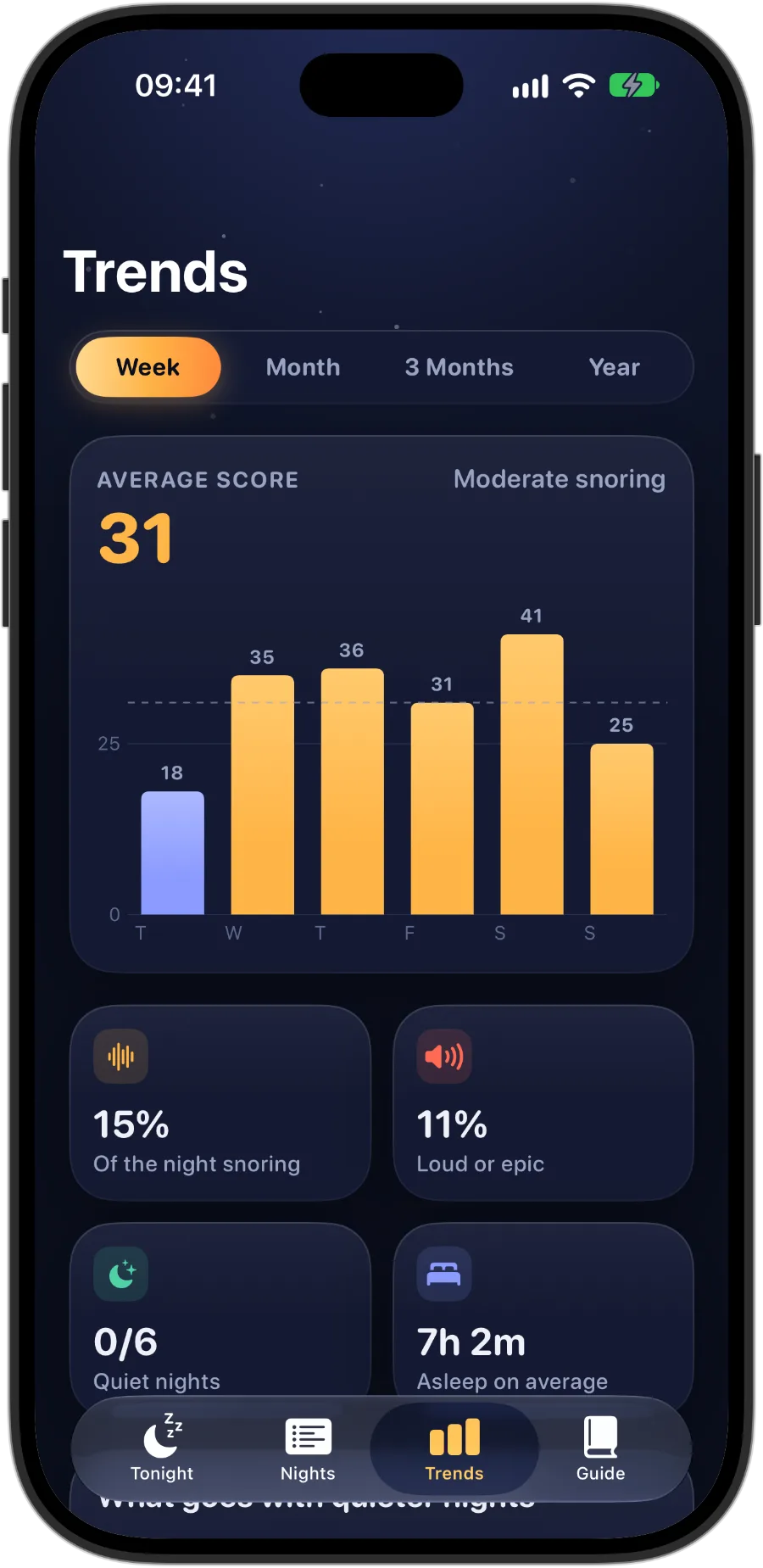
This page is general information, not medical advice. Snores is not a medical device and does not diagnose sleep apnea or any other condition. If you are worried about your sleep or your breathing, talk to a doctor.