REMEDIES
Medical treatments for snoring
CPAP, oral appliances and surgery: what doctors offer, and why a diagnosis comes first.
First, a diagnosis
Before treating snoring medically, doctors check for sleep apnea, usually with a sleep study in a lab or at home 5. The answer changes the treatment: quieting the sound without treating sleep apnea would leave the real problem in place.
CPAP
Continuous positive airway pressure (CPAP) blows a gentle stream of air through a mask to hold the airway open. It is the main treatment for moderate to severe sleep apnea and stops the snoring too. Guidelines recommend it for adults with sleep apnea and excessive sleepiness, and suggest it when sleep apnea affects quality of life or comes with high blood pressure 1. In a 10-year study, men with severe sleep apnea treated with CPAP had a risk of heart attacks and strokes similar to healthy men 6.
Oral appliances
Custom mouthguards that hold the lower jaw forward are recommended for primary snoring, and for sleep apnea in people who can't tolerate CPAP or prefer an alternative 2. See anti-snore mouthguards.
Surgery and procedures
| Procedure | What it does | What studies found |
|---|---|---|
| Uvulopalatopharyngoplasty (UPPP) | Removes or reshapes tissue of the soft palate, uvula and often tonsils | Fewer snores per hour and modestly quieter snoring; mixed objective results |
| Laser-assisted uvulopalatoplasty (LAUP) | Reshapes the soft palate with a laser, often in stages | Subjectively less snoring; not recommended for sleep apnea 4 |
| Radiofrequency ablation | Stiffens the soft palate or tongue base with heat | Partners rated snoring quieter; objective results mixed |
| Palatal implants | Small rods placed in the soft palate to stiffen it | Partners rated snoring quieter; no change in objective measures |
Surgery may help some people when a specific cause, such as very large tonsils or a narrow nose, is found. For sleep apnea, guidelines say its presence and severity must be known before surgery, and that patients should be told about success rates, complications and alternatives such as CPAP and oral appliances 4.
Treatments for the nose
If a deviated septum, nasal polyps or swollen turbinates block the nose, treating them can make breathing easier and other treatments more comfortable. See a blocked nose and allergies.
Is there surgery to stop snoring?
Yes, several procedures, but the evidence is mostly from small, low-quality studies, and results vary 3. Simpler options are usually tried first.
Does CPAP stop snoring?
Yes, CPAP holds the airway open, which stops snoring as well as breathing pauses. It is mainly prescribed for sleep apnea 1.
What kind of doctor treats snoring?
A family doctor is a good start. They may refer you to a sleep specialist, an ear, nose and throat surgeon, or a dentist experienced in sleep medicine.
Does palate surgery work for snoring?
It reduced snoring in studies, but often modestly, and the evidence is weak 3. Discuss the risks and the alternatives with your surgeon.
Sources
- Patil SP, Ayappa IA, Caples SM, Kimoff RJ, Patel SR, Harrod CG. Treatment of adult obstructive sleep apnea with positive airway pressure: an American Academy of Sleep Medicine clinical practice guideline. J Clin Sleep Med. 2019;15(2):335-343. doi.org/10.5664/jcsm.7640
- Ramar K, Dort LC, Katz SG, et al. Clinical practice guideline for the treatment of obstructive sleep apnea and snoring with oral appliance therapy: an update for 2015. J Clin Sleep Med. 2015;11(7):773-827. doi.org/10.5664/jcsm.4858
- Main C, Liu Z, Welch K, Weiner G, Jones SQ, Stein K. Surgical procedures and non-surgical devices for the management of non-apnoeic snoring: a systematic review of clinical effects and associated treatment costs. Health Technol Assess. 2009;13(3):1-208. doi.org/10.3310/hta13030
- Aurora RN, Casey KR, Kristo D, et al. Practice parameters for the surgical modifications of the upper airway for obstructive sleep apnea in adults. Sleep. 2010;33(10):1408-1413. doi.org/10.1093/sleep/33.10.1408
- Kapur VK, Auckley DH, Chowdhuri S, et al. Clinical practice guideline for diagnostic testing for adult obstructive sleep apnea: an American Academy of Sleep Medicine clinical practice guideline. J Clin Sleep Med. 2017;13(3):479-504. doi.org/10.5664/jcsm.6506
- Marin JM, Carrizo SJ, Vicente E, Agusti AG. Long-term cardiovascular outcomes in men with obstructive sleep apnoea-hypopnoea with or without treatment with continuous positive airway pressure: an observational study. Lancet. 2005;365(9464):1046-1053. doi.org/10.1016/S0140-6736(05)71141-7
- Pevernagie D, Aarts RM, De Meyer M. The acoustics of snoring. Sleep Med Rev. 2010;14(2):131-144. doi.org/10.1016/j.smrv.2009.06.002
COMING SOON
Find out
how you snore.
Snores listens through the night on your iPhone and shows you in the morning how much and how loudly you snored, with clips of the loudest moments. Tag what you tried and see what goes with quieter nights. The sound stays on your iPhone.
Meet Snores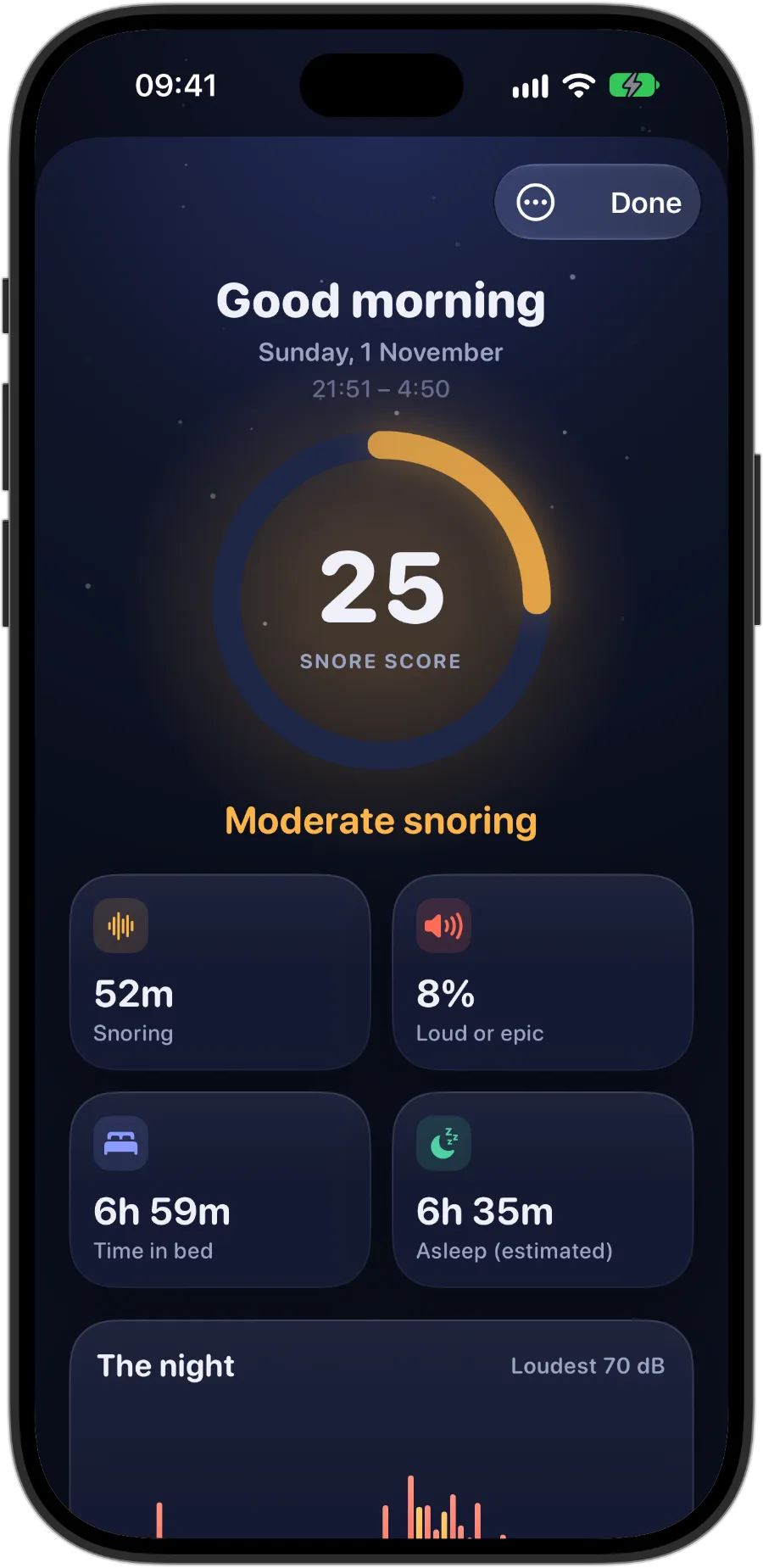
This page is general information, not medical advice. Snores is not a medical device and does not diagnose sleep apnea or any other condition. If you are worried about your sleep or your breathing, talk to a doctor.