REMEDIES
Tongue-retaining devices
A different kind of mouthpiece for tongue snorers, and for people whose teeth can't hold a mouthguard.
- Best for
- Tongue snorers; few or weak teeth; dentures
- Evidence
- Moderate: small trials and long-term follow-up
- Cost
- Low for ready-made, higher for custom
- Needs
- A nose you can breathe through all night
How it works
A tongue-retaining device, or TRD, has a soft bulb at the front. You squeeze it, put the tip of your tongue inside and let go: gentle suction holds the tongue forward between your lips all night. Unlike an anti-snore mouthguard, it doesn't grip the teeth or move the jaw, which is why it can suit people with dentures, few teeth or jaw problems.
What the research found
Key study
Suction or no suction?
- Randomized crossover
- Sleep-disordered breathing
- Non-custom device
People with snoring and sleep-disordered breathing used a ready-made tongue-retaining device with suction and an identical one without suction, in random order. Only the suction device significantly reduced breathing events (from 15.5 to 8.9 an hour) and the snoring index (from 214.7 to 132.9 snores an hour). Just over half said they would keep using it.
In a French study of 84 people with sleep apnea fitted with a custom device and followed for a median of five years, 71% had a complete or partial response, snoring intensity fell by 68%, and 52% were still using it. A blocked nose was the strongest predictor of giving up 2. The authors found its results similar to those of jaw-advancing mouthguards.
Side effects
- Drooling or a dry mouth at first.
- A sore tongue tip, especially in the first weeks.
- Difficulty if your nose blocks during the night: you can't breathe through your mouth with it in.
Good for
- Snoring that is worse on your back
- Dentures, few teeth or jaw problems
- Trying a device before a custom mouthguard
Watch out for
- Takes getting used to
- Needs a clear nose all night 2
- Less studied than jaw-advancing mouthguards
Do tongue-retaining devices work for snoring?
They reduced snoring in a randomized trial 1 and in long-term follow-up 2, though they've been studied less than jaw-advancing mouthguards.
Is a tongue-retaining device better than a mouthguard?
Neither is better for everyone. Long-term results looked similar 2. A tongue device suits people whose teeth can't hold a mouthguard.
Can I use one with dentures?
Often, yes, because it doesn't rely on the teeth. Ask your dentist.
How do I know if I'm a tongue snorer?
Try the tongue test in types of snoring, and see whether your snoring is much louder on your back.
Sources
- Dort L, Brant R. A randomized, controlled, crossover study of a noncustomized tongue retaining device for sleep disordered breathing. Sleep Breath. 2008;12(4):369-373. doi.org/10.1007/s11325-008-0187-5
- Lazard DS, Blumen M, Lévy P, et al. The tongue-retaining device: efficacy and side effects in obstructive sleep apnea syndrome. J Clin Sleep Med. 2009;5(5):431-438. doi.org/10.5664/jcsm.27598
COMING SOON
Snore less.
Find what works.
Snores measures your snoring every night, suggests which remedies to try, guides a few minutes of throat exercises a day and shows which changes go with quieter nights for you. The sound stays on your iPhone.
Meet Snores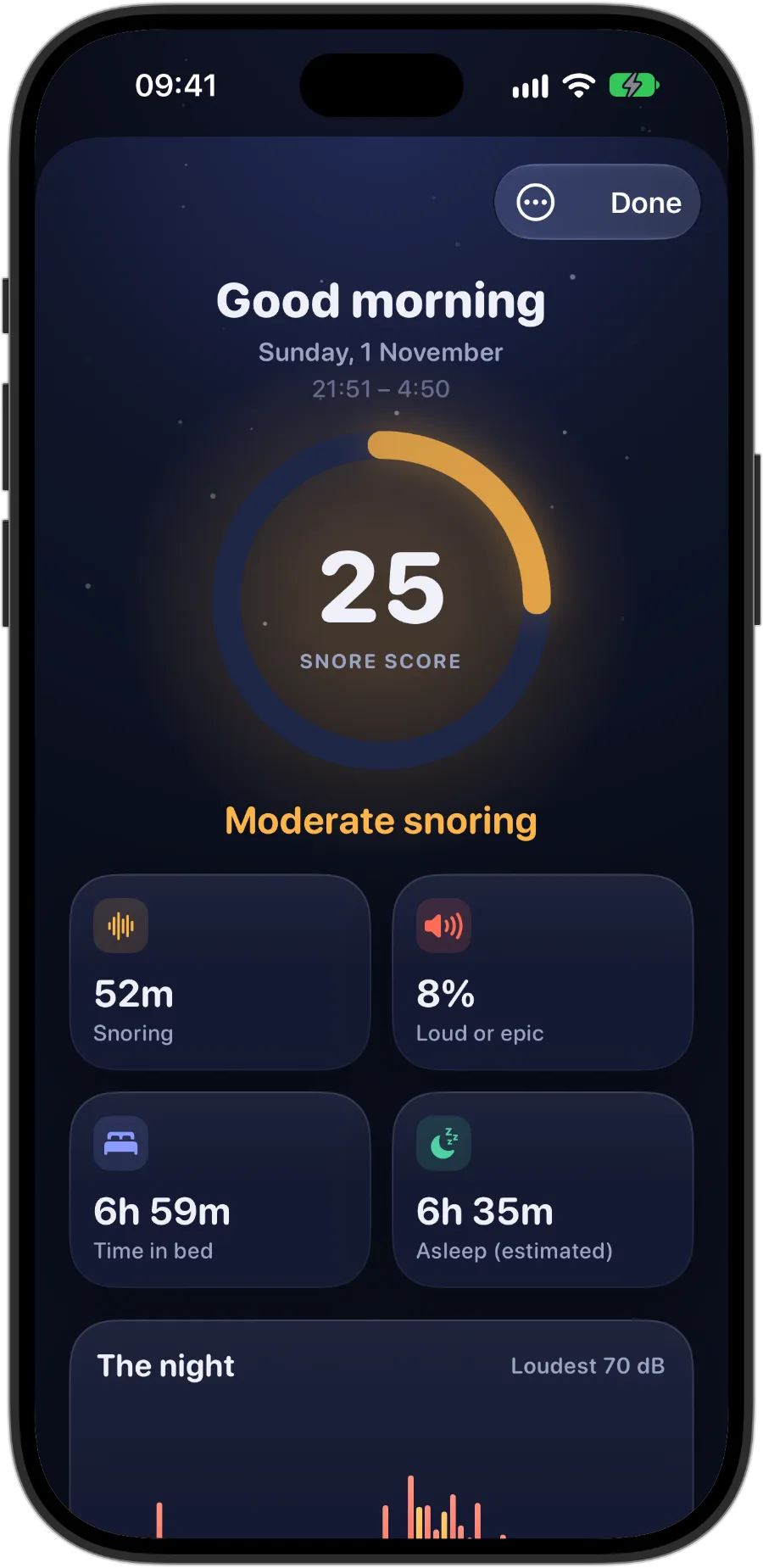
This page is general information, not medical advice. Snores is not a medical device and does not diagnose sleep apnea or any other condition. If you are worried about your sleep or your breathing, talk to a doctor.