ANSWERS
Do anti-snoring devices work?
Some have good evidence, some a little, some none. Here's the honest list.
| Device | Best for | Evidence |
|---|---|---|
| Mandibular advancement mouthguard | Persistent snoring; mild to moderate sleep apnea | Strong 1,4 |
| Tongue-retaining device | Tongue snorers; people with few teeth | Moderate 2,5 |
| Positional pillow or device | Back snorers | Moderate, in positional sleep apnea 6,7 |
| Nasal strips and dilators | Snoring from the nose | Mixed 8,9 |
| Mouth tape | Mouth breathers with a clear nose | Weak, with risks 10 |
| Chin strap | Little evidence for anyone | Weak 3 |
| CPAP | Sleep apnea | Strong, for sleep apnea 11 |
| Smart gadgets that vibrate or buzz | Back snorers, possibly | Little independent research |
Choosing a device
How to choose
- Work out what type of snorer you are.
- Pick the device that targets it, starting with the cheapest that fits.
- Use it every night for one to two weeks.
- Compare with nights without it.
- For a mouthguard, if a boil-and-bite helps a little, a custom one from a dentist may help more 1.
What is the most effective anti-snoring device?
Mouthguards that hold the lower jaw forward have the strongest evidence 1,4.
Do anti-snoring wristbands or rings work?
There's no good evidence that wristbands, rings or magnets reduce snoring.
Do nasal strips work as well as mouthguards?
Usually not. Strips only help snoring that starts in the nose 9, while mouthguards target the throat.
Are anti-snoring devices safe?
Most are, used as directed. Mouthguards can cause jaw soreness, and mouth tape is risky with a blocked nose or possible sleep apnea 10.
Sources
- Ramar K, Dort LC, Katz SG, et al. Clinical practice guideline for the treatment of obstructive sleep apnea and snoring with oral appliance therapy: an update for 2015. J Clin Sleep Med. 2015;11(7):773-827. doi.org/10.5664/jcsm.4858
- Dort L, Brant R. A randomized, controlled, crossover study of a noncustomized tongue retaining device for sleep disordered breathing. Sleep Breath. 2008;12(4):369-373. doi.org/10.1007/s11325-008-0187-5
- Bhat S, Gushway-Henry N, Polos PG, et al. The efficacy of a chinstrap in treating sleep disordered breathing and snoring. J Clin Sleep Med. 2014;10(8):887-892. doi.org/10.5664/jcsm.3962
- Main C, Liu Z, Welch K, Weiner G, Jones SQ, Stein K. Surgical procedures and non-surgical devices for the management of non-apnoeic snoring: a systematic review of clinical effects and associated treatment costs. Health Technol Assess. 2009;13(3):1-208. doi.org/10.3310/hta13030
- Lazard DS, Blumen M, Lévy P, et al. The tongue-retaining device: efficacy and side effects in obstructive sleep apnea syndrome. J Clin Sleep Med. 2009;5(5):431-438. doi.org/10.5664/jcsm.27598
- Newell J, Mairesse O, Neu D. Can positional therapy be simple, effective and well tolerated all together? A prospective study on treatment response and compliance in positional sleep apnea with a positioning pillow. Sleep Breath. 2018;22(4):1143-1151. doi.org/10.1007/s11325-018-1650-6
- Benoist L, de Ruiter M, de Lange J, de Vries N. A randomized, controlled trial of positional therapy versus oral appliance therapy for position-dependent sleep apnea. Sleep Med. 2017;34:109-117. doi.org/10.1016/j.sleep.2017.01.024
- Löth S, Petruson B. Improved nasal breathing reduces snoring and morning tiredness: a 6-month follow-up study. Arch Otolaryngol Head Neck Surg. 1996;122(12):1337-1340. doi.org/10.1001/archotol.1996.01890240045010
- Camacho M, Malu OO, Kram YA, et al. Nasal dilators (Breathe Right strips and NoZovent) for snoring and OSA: a systematic review and meta-analysis. Pulm Med. 2016;2016:4841310. doi.org/10.1155/2016/4841310
- Rhee J, Iansavitchene A, Mannala S, Graham ME, Rotenberg B. Breaking social media fads and uncovering the safety and efficacy of mouth taping in patients with mouth breathing, sleep disordered breathing, or obstructive sleep apnea: a systematic review. PLoS One. 2025;20(5):e0323643. doi.org/10.1371/journal.pone.0323643
- Patil SP, Ayappa IA, Caples SM, Kimoff RJ, Patel SR, Harrod CG. Treatment of adult obstructive sleep apnea with positive airway pressure: an American Academy of Sleep Medicine clinical practice guideline. J Clin Sleep Med. 2019;15(2):335-343. doi.org/10.5664/jcsm.7640
COMING SOON
Snore less.
Find what works.
Snores measures your snoring every night, suggests which remedies to try, guides a few minutes of throat exercises a day and shows which changes go with quieter nights for you. The sound stays on your iPhone.
Meet Snores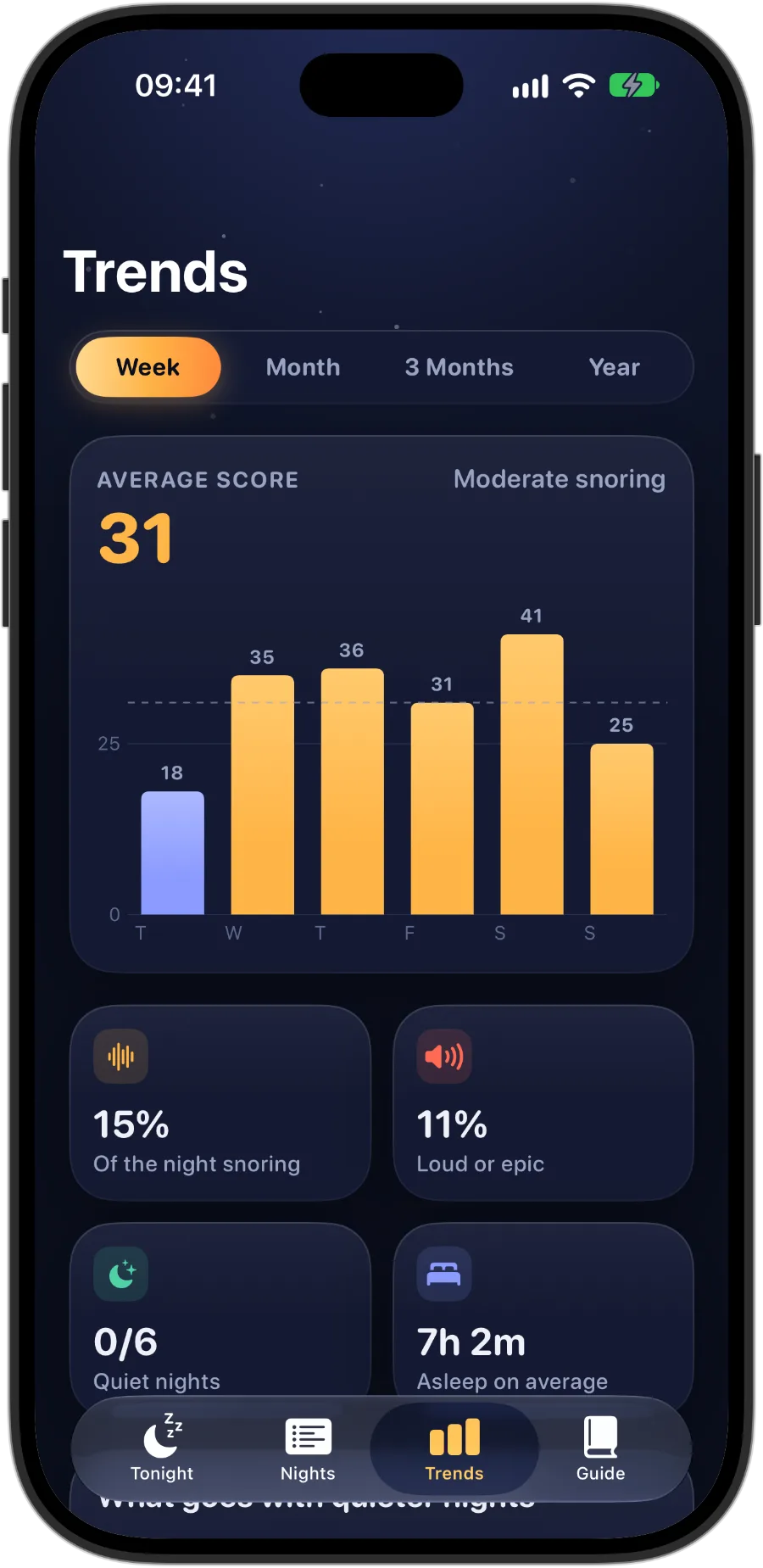
This page is general information, not medical advice. Snores is not a medical device and does not diagnose sleep apnea or any other condition. If you are worried about your sleep or your breathing, talk to a doctor.