REMEDIES
Natural ways to stop snoring
Twelve drug-free changes, from the best supported to the least, and how to tell which ones work for you.
| Remedy | Evidence | Works in |
|---|---|---|
| Sleep on your side | Moderate 1 | The first night |
| Skip alcohol before bed | Moderate 2,5 | The first night |
| Lose weight if you carry extra | Moderate 3,6 | Weeks to months |
| Mouth and throat exercises | Moderate 4,7 | Several weeks |
| Clear a blocked nose | Moderate 8,9 | Days |
| Stop smoking | Moderate 10 | Weeks to months |
| Regular exercise | Moderate, in sleep apnea 11 | Weeks |
| Singing or a wind instrument | Weak 12,13 | Months |
| Raise the head of the bed | Weak, in sleep apnea 14 | The first night |
| An anti-snore pillow | Weak to moderate 15 | The first night |
| Regular sleep, not overtired | Little direct research | Days |
| A humidifier | Little direct research | Days |
1. Sleep on your side
On your back, gravity pulls the tongue and soft palate towards the throat. In a sleep lab study of 72 habitual snorers, most of those without sleep apnea snored less and more quietly on their side 1. A body pillow, a pillow behind your back or a positional pillow helps you stay there.
2. Skip alcohol in the evening
Alcohol relaxes the throat muscles and dulls the reflexes that keep the airway open. In a sleep lab study, it brought on pauses in breathing in people who normally only snored 2. Stopping a few hours before bed is often enough to notice a difference.
3. Lose weight if you carry extra
Fat in and around the throat narrows the airway. In a four-year study, a 10% weight loss went with a 26% fall in sleep apnea severity 3, and in men who snored heavily, losing 3 kg or more nearly halved their snores per hour 6.
4. Train your mouth and throat
Daily exercises for the tongue, soft palate and throat reduced snoring in randomized trials. Three months of exercises cut the snore index roughly in half 4, and a review of nine studies found snoring loudness fell by about half 7. See the eight exercises.
5. Clear your nose
A blocked nose makes you breathe harder and through your mouth. Saline rinses are drug-free and safe to use every day; for allergies, a steroid spray improved congestion and sleep in a trial 9; nasal strips open the nostrils from outside 16.
6. Stop smoking
Current smokers were 2.3 times as likely to snore as people who had never smoked, while former smokers weren't at higher risk 10.
7. Move more
In people with sleep apnea, supervised exercise training reduced the number of breathing events by about six an hour, with little change in weight, and improved sleepiness 11. There's less research on simple snoring, but regular activity is good for sleep in general.
8. Sing or play a wind instrument
Singing exercises for 20 minutes a day reduced snoring in a small pilot study 12, and learning the didgeridoo improved sleepiness and partners' sleep in a small trial 13. If you'd enjoy it anyway, it's a pleasant way to train the same muscles.
9 to 12. Small changes worth testing
- Raise the head of the bed a little if you can't stay on your side; a 7.5-degree tilt reduced breathing pauses in sleep apnea 14.
- An anti-snore pillow that keeps you on your side; a positioning pillow worked well and was well tolerated in a study of positional sleep apnea 15.
- Keep regular hours. Being very tired seems to make snoring heavier for many people, although the research is thin.
- A humidifier for dry, heated air, which may ease an irritated nose and throat.
What is the best natural remedy for snoring?
For most people, sleeping on their side and skipping alcohol before bed are the quickest wins. Weight loss and throat exercises take longer but are well supported 3,4.
How can I stop snoring naturally tonight?
Sleep on your side, skip alcohol, clear your nose with saline or a strip, and raise the head of your bed a little. See how to stop snoring tonight.
Do natural snoring remedies really work?
Several are backed by studies, though none works for everyone. Testing one at a time on your own nights is the way to find yours.
Does honey or olive oil stop snoring?
There's no good evidence that honey, olive oil, peppermint or other home remedies reduce snoring.
Sources
- Nakano H, Ikeda T, Hayashi M, Ohshima E, Onizuka A. Effects of body position on snoring in apneic and nonapneic snorers. Sleep. 2003;26(2):169-172. doi.org/10.1093/sleep/26.2.169
- Issa FG, Sullivan CE. Alcohol, snoring and sleep apnea. J Neurol Neurosurg Psychiatry. 1982;45(4):353-359. doi.org/10.1136/jnnp.45.4.353
- Peppard PE, Young T, Palta M, Dempsey J, Skatrud J. Longitudinal study of moderate weight change and sleep-disordered breathing. JAMA. 2000;284(23):3015-3021. doi.org/10.1001/jama.284.23.3015
- Ieto V, Kayamori F, Montes MI, et al. Effects of oropharyngeal exercises on snoring: a randomized trial. Chest. 2015;148(3):683-691. doi.org/10.1378/chest.14-2953
- Simou E, Britton J, Leonardi-Bee J. Alcohol and the risk of sleep apnoea: a systematic review and meta-analysis. Sleep Med. 2018;42:38-46. doi.org/10.1016/j.sleep.2017.12.005
- Braver HM, Block AJ, Perri MG. Treatment for snoring: combined weight loss, sleeping on side, and nasal spray. Chest. 1995;107(5):1283-1288. doi.org/10.1378/chest.107.5.1283
- Camacho M, Guilleminault C, Wei JM, et al. Oropharyngeal and tongue exercises (myofunctional therapy) for snoring: a systematic review and meta-analysis. Eur Arch Otorhinolaryngol. 2018;275(4):849-855. doi.org/10.1007/s00405-017-4848-5
- Young T, Finn L, Kim H. Nasal obstruction as a risk factor for sleep-disordered breathing. J Allergy Clin Immunol. 1997;99(2):S757-S762. doi.org/10.1016/S0091-6749(97)70124-6
- Craig TJ, Teets S, Lehman EB, Chinchilli VM, Zwillich C. Nasal congestion secondary to allergic rhinitis as a cause of sleep disturbance and daytime fatigue and the response to topical nasal corticosteroids. J Allergy Clin Immunol. 1998;101(5):633-637. doi.org/10.1016/S0091-6749(98)70171-X
- Wetter DW, Young TB, Bidwell TR, Badr MS, Palta M. Smoking as a risk factor for sleep-disordered breathing. Arch Intern Med. 1994;154(19):2219-2224. doi.org/10.1001/archinte.1994.00420190121014
- Iftikhar IH, Kline CE, Youngstedt SD. Effects of exercise training on sleep apnea: a meta-analysis. Lung. 2014;192(1):175-184. doi.org/10.1007/s00408-013-9511-3
- Ojay A, Ernst E. Can singing exercises reduce snoring? A pilot study. Complement Ther Med. 2000;8(3):151-156. doi.org/10.1054/ctim.2000.0376
- Puhan MA, Suarez A, Lo Cascio C, et al. Didgeridoo playing as alternative treatment for obstructive sleep apnoea syndrome: randomised controlled trial. BMJ. 2006;332(7536):266-270. doi.org/10.1136/bmj.38705.470590.55
- Souza FJFB, Genta PR, de Souza Filho AJ, Wellman A, Lorenzi-Filho G. The influence of head-of-bed elevation in patients with obstructive sleep apnea. Sleep Breath. 2017;21(4):815-820. doi.org/10.1007/s11325-017-1524-3
- Newell J, Mairesse O, Neu D. Can positional therapy be simple, effective and well tolerated all together? A prospective study on treatment response and compliance in positional sleep apnea with a positioning pillow. Sleep Breath. 2018;22(4):1143-1151. doi.org/10.1007/s11325-018-1650-6
- Löth S, Petruson B. Improved nasal breathing reduces snoring and morning tiredness: a 6-month follow-up study. Arch Otolaryngol Head Neck Surg. 1996;122(12):1337-1340. doi.org/10.1001/archotol.1996.01890240045010
COMING SOON
Snore less.
Find what works.
Snores measures your snoring every night, suggests which remedies to try, guides a few minutes of throat exercises a day and shows which changes go with quieter nights for you. The sound stays on your iPhone.
Meet Snores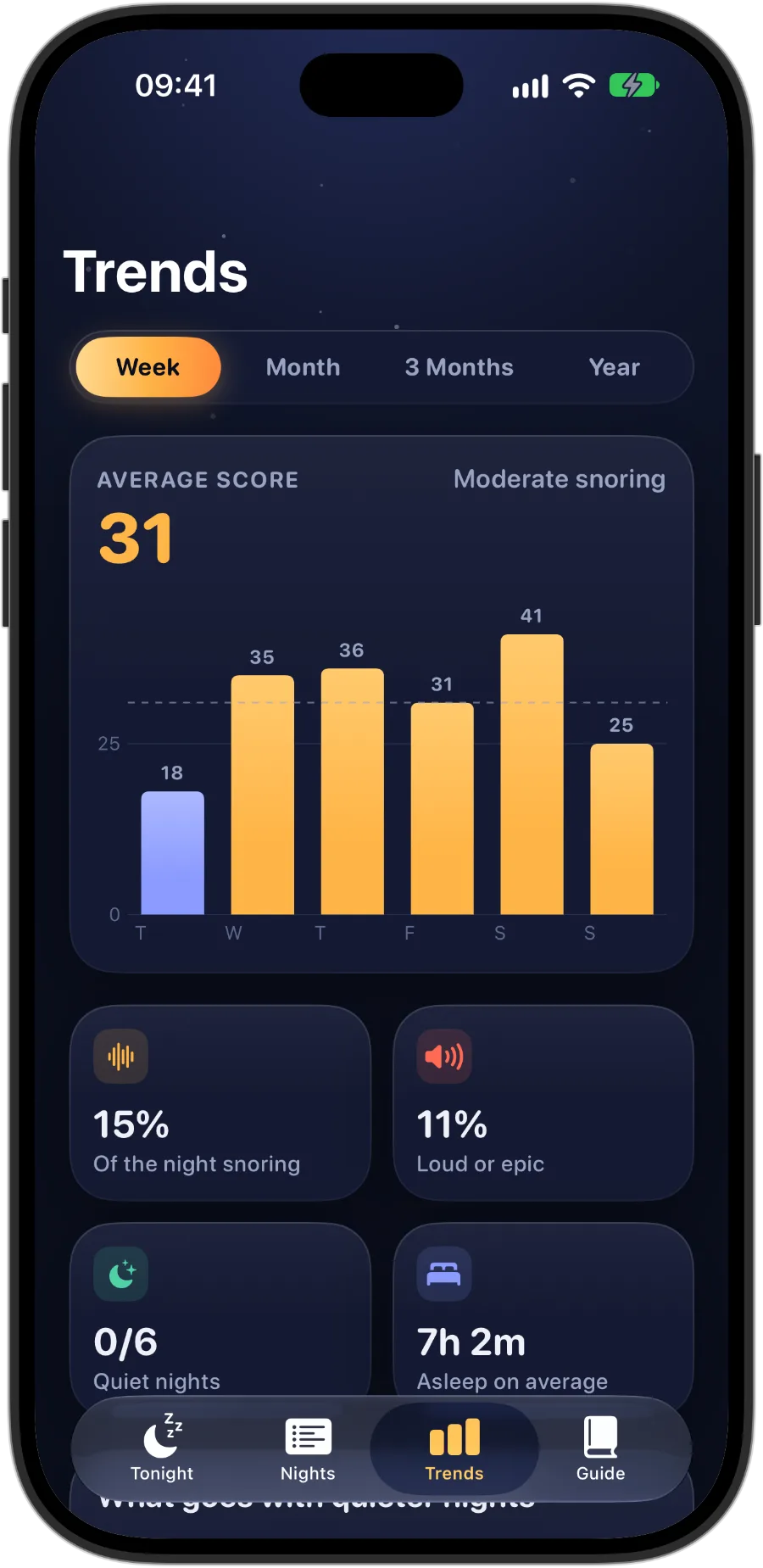
This page is general information, not medical advice. Snores is not a medical device and does not diagnose sleep apnea or any other condition. If you are worried about your sleep or your breathing, talk to a doctor.