REMEDIES
A 30-day plan to snore less
Four weeks, one change at a time, with daily exercises building up in the background.
| Week | Change | Why |
|---|---|---|
| 1 (days 1 to 7) | Measure only, plus daily throat exercises | You need a baseline; exercises take weeks 2 |
| 2 (days 8 to 14) | Sleep on your side | The quickest win for many snorers 4 |
| 3 (days 15 to 21) | No alcohol within 3 hours of bed; earlier dinner | Alcohol makes snoring worse early in the night 5 |
| 4 (days 22 to 30) | Clear your nose, or a device that fits your type | Targets what's left 6,7 |
Week 1: measure, and start the exercises
Days 1 to 7
- Record every night the same way: phone on the nightstand, about an arm's length away, plugged in.
- Change nothing else, so you learn what a normal week looks like.
- Start the mouth and throat exercises, five minutes a day, at a fixed time such as after brushing your teeth.
- Note anything unusual: a cold, a late night, drinks.
Week 2: sleep on your side
Days 8 to 14
- Put a pillow behind your back, or hug a long body pillow.
- If you keep rolling back, try an anti-snore pillow or a soft backpack.
- Keep up the exercises.
- At the end of the week, compare with week 1.
Week 3: your evenings
Days 15 to 21
- No alcohol in the three hours before bed.
- Finish dinner two to three hours before bed.
- Keep sleeping on your side if it helped, and keep up the exercises.
- Compare with week 2.
Week 4: what's left
Pick the change that matches your strongest remaining clue (see types of snoring):
- a stuffy nose: saline rinses and nasal strips;
- snoring with the mouth open and a clear nose: keeping the mouth closed, carefully (see mouth taping);
- still snoring on your side, or a small lower jaw: ask a dentist about an anti-snore mouthguard.
Day 30: review
Compare the average of each week with week 1. Keep every change that went with quieter nights, and drop the ones that didn't. Carry on with the exercises for at least three months: in the trials, that's how long they ran 2,8.
How long does it take to stop snoring?
Some changes, like side sleeping, work the first night. Exercises and weight loss take weeks to months 2,9.
Can I do several changes at once?
You can, but you won't know which helped. One change a week is a good balance.
What if nothing works after 30 days?
Read why your remedy isn't working, and consider seeing a doctor or a dentist.
Should I keep doing the exercises after 30 days?
Yes. In studies they ran for three months, and their effect seems to need regular practice 2.
Sources
- Pevernagie D, Aarts RM, De Meyer M. The acoustics of snoring. Sleep Med Rev. 2010;14(2):131-144. doi.org/10.1016/j.smrv.2009.06.002
- Ieto V, Kayamori F, Montes MI, et al. Effects of oropharyngeal exercises on snoring: a randomized trial. Chest. 2015;148(3):683-691. doi.org/10.1378/chest.14-2953
- Lally P, van Jaarsveld CHM, Potts HWW, Wardle J. How are habits formed: modelling habit formation in the real world. Eur J Soc Psychol. 2010;40(6):998-1009. doi.org/10.1002/ejsp.674
- Nakano H, Ikeda T, Hayashi M, Ohshima E, Onizuka A. Effects of body position on snoring in apneic and nonapneic snorers. Sleep. 2003;26(2):169-172. doi.org/10.1093/sleep/26.2.169
- Issa FG, Sullivan CE. Alcohol, snoring and sleep apnea. J Neurol Neurosurg Psychiatry. 1982;45(4):353-359. doi.org/10.1136/jnnp.45.4.353
- Young T, Finn L, Kim H. Nasal obstruction as a risk factor for sleep-disordered breathing. J Allergy Clin Immunol. 1997;99(2):S757-S762. doi.org/10.1016/S0091-6749(97)70124-6
- Ramar K, Dort LC, Katz SG, et al. Clinical practice guideline for the treatment of obstructive sleep apnea and snoring with oral appliance therapy: an update for 2015. J Clin Sleep Med. 2015;11(7):773-827. doi.org/10.5664/jcsm.4858
- Guimarães KC, Drager LF, Genta PR, Marcondes BF, Lorenzi-Filho G. Effects of oropharyngeal exercises on patients with moderate obstructive sleep apnea syndrome. Am J Respir Crit Care Med. 2009;179(10):962-966. doi.org/10.1164/rccm.200806-981OC
- Peppard PE, Young T, Palta M, Dempsey J, Skatrud J. Longitudinal study of moderate weight change and sleep-disordered breathing. JAMA. 2000;284(23):3015-3021. doi.org/10.1001/jama.284.23.3015
COMING SOON
Snore less.
Find what works.
Snores measures your snoring every night, suggests which remedies to try, guides a few minutes of throat exercises a day and shows which changes go with quieter nights for you. The sound stays on your iPhone.
Meet Snores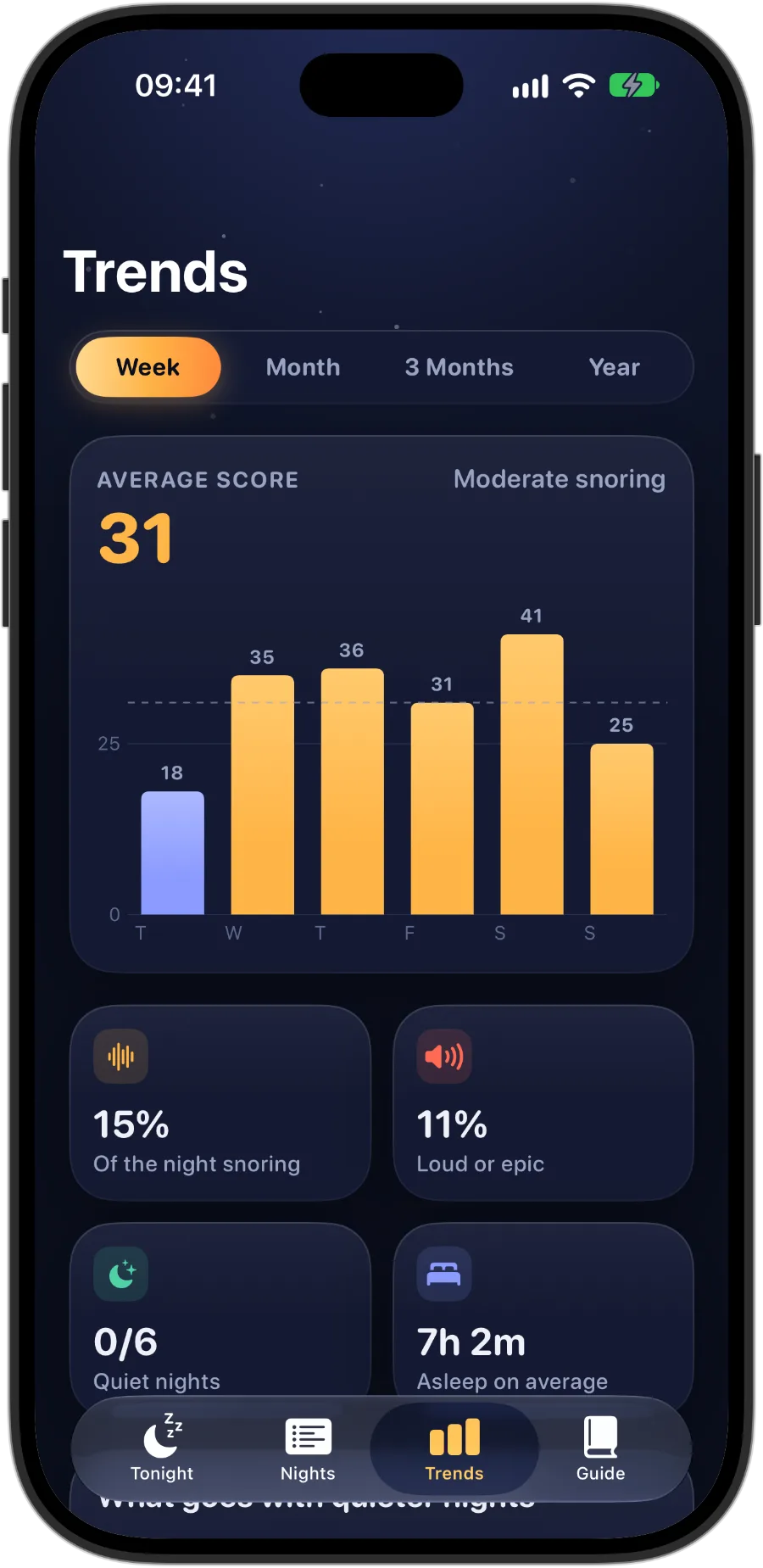
This page is general information, not medical advice. Snores is not a medical device and does not diagnose sleep apnea or any other condition. If you are worried about your sleep or your breathing, talk to a doctor.