REMEDIES
Anti-snore pillows
Pillows that keep you off your back can help back snorers. Others promise more than the evidence shows.
- Best for
- Back snorers
- Evidence
- Weak to moderate, mostly in positional sleep apnea
- Cost
- Low to moderate
- Time to work
- The first night
The kinds of pillow
| Kind | How it works | Evidence |
|---|---|---|
| Positional pillow | A shaped pillow or cushion that makes lying on your back awkward and supports you on your side | A positioning pillow worked and was well tolerated in a 6-month study 1 |
| Body pillow or backpack | Something behind your back that stops you rolling over | Effective while used, but many people stop 3 |
| Wedge pillow | Raises your head and shoulders at a gentle slope | A 7.5-degree tilt reduced breathing pauses 4 |
| Contour or cervical pillow | Supports the neck in a set curve | Little evidence for snoring |
| Smart pillow | Detects snoring and nudges you by vibrating or changing shape | Little independent research |
What the research found
Key study
A positioning pillow for a month and beyond
- 28 adults
- Positional sleep apnea
- Sleep lab, 1 and 6 months
People whose sleep apnea was worse on their back slept in the lab without and then with a sleep-positioning pillow, and again after a month of using it at home. With the pillow, they spent less time on their back and had fewer breathing events, less broken sleep and fewer drops in oxygen, from the first night and still after a month. Sleepiness and sleep quality improved, and satisfaction and use stayed high at six months.
A review of positional therapy found that about 56% of people with sleep apnea are position-dependent, and that the main problem with positional devices is that people stop using them over time 2. The classic tennis ball sewn into a T-shirt is a case in point: after 2.5 years, only 6% of people were still using it, mostly because it was uncomfortable 3. A comfortable pillow may be easier to keep up.
Choosing one
How to choose
- First, check you snore mostly on your back: tag a week of nights with your position.
- If you do, choose something that keeps you on your side and that you find comfortable.
- If you can't stay off your back at all, try a wedge that lifts your shoulders as well as your head.
- Give it a week, then compare with nights without it.
Do anti-snore pillows really work?
Pillows that keep you on your side can help back snorers 1. Pillows that only reshape the neck have little evidence.
What is the best pillow for snoring?
The best one is a pillow that keeps you off your back and that you find comfortable enough to use every night.
Does a wedge pillow help snoring?
It can, if it lifts your shoulders and back. A gentle tilt reduced breathing pauses in sleep apnea 4.
Do smart anti-snore pillows work?
There's little independent research. If you try one, compare your nights with and without it.
Sources
- Newell J, Mairesse O, Neu D. Can positional therapy be simple, effective and well tolerated all together? A prospective study on treatment response and compliance in positional sleep apnea with a positioning pillow. Sleep Breath. 2018;22(4):1143-1151. doi.org/10.1007/s11325-018-1650-6
- Ravesloot MJL, van Maanen JP, Dun L, de Vries N. The undervalued potential of positional therapy in position-dependent snoring and obstructive sleep apnea: a review of the literature. Sleep Breath. 2013;17(1):39-49. doi.org/10.1007/s11325-012-0683-5
- Bignold JJ, Deans-Costi G, Goldsworthy MR, et al. Poor long-term patient compliance with the tennis ball technique for treating positional obstructive sleep apnea. J Clin Sleep Med. 2009;5(5):428-430. doi.org/10.5664/jcsm.27597
- Souza FJFB, Genta PR, de Souza Filho AJ, Wellman A, Lorenzi-Filho G. The influence of head-of-bed elevation in patients with obstructive sleep apnea. Sleep Breath. 2017;21(4):815-820. doi.org/10.1007/s11325-017-1524-3
COMING SOON
Snore less.
Find what works.
Snores measures your snoring every night, suggests which remedies to try, guides a few minutes of throat exercises a day and shows which changes go with quieter nights for you. The sound stays on your iPhone.
Meet Snores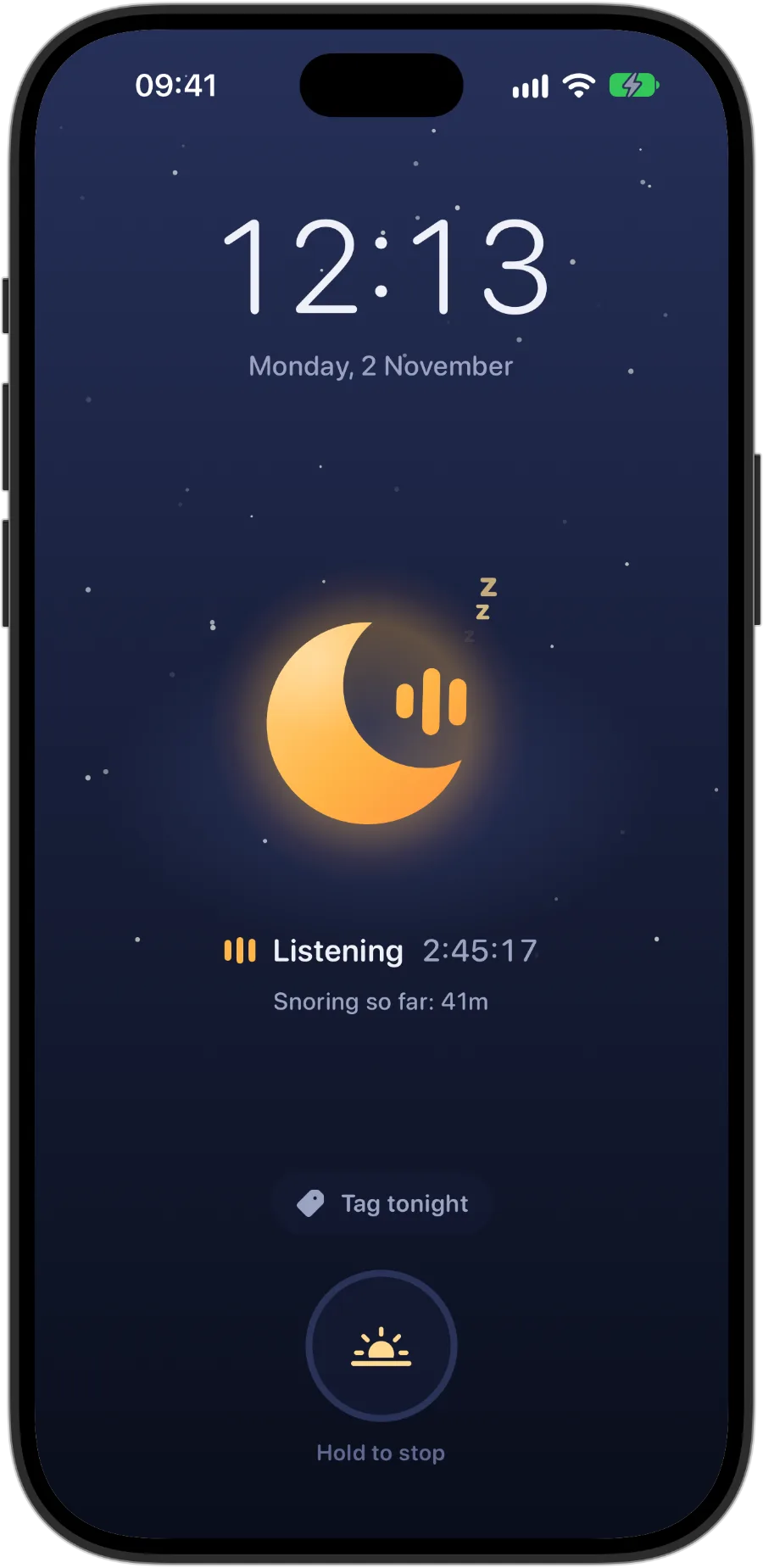
This page is general information, not medical advice. Snores is not a medical device and does not diagnose sleep apnea or any other condition. If you are worried about your sleep or your breathing, talk to a doctor.