REMEDIES
Why your snoring remedy isn't working
Eight common reasons a remedy seems to fail, and how to fix each one.
1. It doesn't match your type of snoring
A nasal strip can't stop a tongue from falling back, and side sleeping won't fix a blocked nose. Work out what type of snorer you are and pick the remedy that targets it.
2. Too few nights
Snoring changes with position, sleep stage and much more 1. A single loud night with a new remedy doesn't mean it failed, and a single quiet night doesn't mean it worked. Give most remedies a week, a mouthguard two, and exercises several weeks.
3. Something else is louder
A remedy can be working while alcohol, a cold or a very late night pushes your snoring up. Record those nights too, and compare like with like. See testing a remedy.
4. It isn't used every night
Positional devices and mouthpieces only work when they're in use, and many people drift away from them. Only 6% of people were still using the tennis ball technique after 2.5 years 2, and about half were still using a tongue-retaining device after five 3. Choosing something comfortable is half the battle.
5. A poor fit
Boil-and-bite mouthguards can slip or be too uncomfortable to keep in. Guidelines prefer custom, adjustable devices made by a dentist for sleep apnea 5. If an off-the-shelf device seemed to help a little, a custom one may help more.
6. Your nose is blocked
Many remedies, from mouth tape to tongue devices, need a nose you can breathe through. In long-term follow-up, a blocked nose was the strongest reason people gave up a tongue-retaining device 3. Treat the nose first: see a blocked nose and allergies.
7. The goal is too strict
Most remedies reduce snoring rather than abolish it: throat exercises roughly halved snoring in a trial 6, for example. A clear, lasting drop in your average is a success, even if you still snore a little.
8. It might be sleep apnea
If your snoring is loud, persistent and nothing touches it, or comes with pauses, gasping or daytime sleepiness, a sleep study can find out whether sleep apnea is involved 4. See snoring or sleep apnea?.
What to do next
- Check your type of snoring and choose a matching remedy.
- Record a baseline week, then test one remedy for at least a week.
- Tag alcohol, colds and late nights so they don't hide the effect.
- Use the remedy every night, and make it comfortable.
- Treat a blocked nose first.
- If nothing helps, see a doctor or a dentist.
Why is my anti-snoring mouthguard not working?
It may not fit well, it may need adjusting, or your snoring may come from your nose. A dentist can check the fit; guidelines prefer custom, adjustable devices 5.
Why do I still snore on my side?
Your snoring may come from your nose, alcohol or the shape of your airway. Some people with sleep apnea snore in every position 7.
How long should I try a snoring remedy before giving up?
About a week for most remedies, two weeks for a mouthguard and around three months for exercises.
What should I do if nothing stops my snoring?
See a doctor, who may arrange a sleep study 4, or a dentist experienced in sleep medicine.
Sources
- Pevernagie D, Aarts RM, De Meyer M. The acoustics of snoring. Sleep Med Rev. 2010;14(2):131-144. doi.org/10.1016/j.smrv.2009.06.002
- Bignold JJ, Deans-Costi G, Goldsworthy MR, et al. Poor long-term patient compliance with the tennis ball technique for treating positional obstructive sleep apnea. J Clin Sleep Med. 2009;5(5):428-430. doi.org/10.5664/jcsm.27597
- Lazard DS, Blumen M, Lévy P, et al. The tongue-retaining device: efficacy and side effects in obstructive sleep apnea syndrome. J Clin Sleep Med. 2009;5(5):431-438. doi.org/10.5664/jcsm.27598
- Kapur VK, Auckley DH, Chowdhuri S, et al. Clinical practice guideline for diagnostic testing for adult obstructive sleep apnea: an American Academy of Sleep Medicine clinical practice guideline. J Clin Sleep Med. 2017;13(3):479-504. doi.org/10.5664/jcsm.6506
- Ramar K, Dort LC, Katz SG, et al. Clinical practice guideline for the treatment of obstructive sleep apnea and snoring with oral appliance therapy: an update for 2015. J Clin Sleep Med. 2015;11(7):773-827. doi.org/10.5664/jcsm.4858
- Ieto V, Kayamori F, Montes MI, et al. Effects of oropharyngeal exercises on snoring: a randomized trial. Chest. 2015;148(3):683-691. doi.org/10.1378/chest.14-2953
- Nakano H, Ikeda T, Hayashi M, Ohshima E, Onizuka A. Effects of body position on snoring in apneic and nonapneic snorers. Sleep. 2003;26(2):169-172. doi.org/10.1093/sleep/26.2.169
COMING SOON
Snore less.
Find what works.
Snores measures your snoring every night, suggests which remedies to try, guides a few minutes of throat exercises a day and shows which changes go with quieter nights for you. The sound stays on your iPhone.
Meet Snores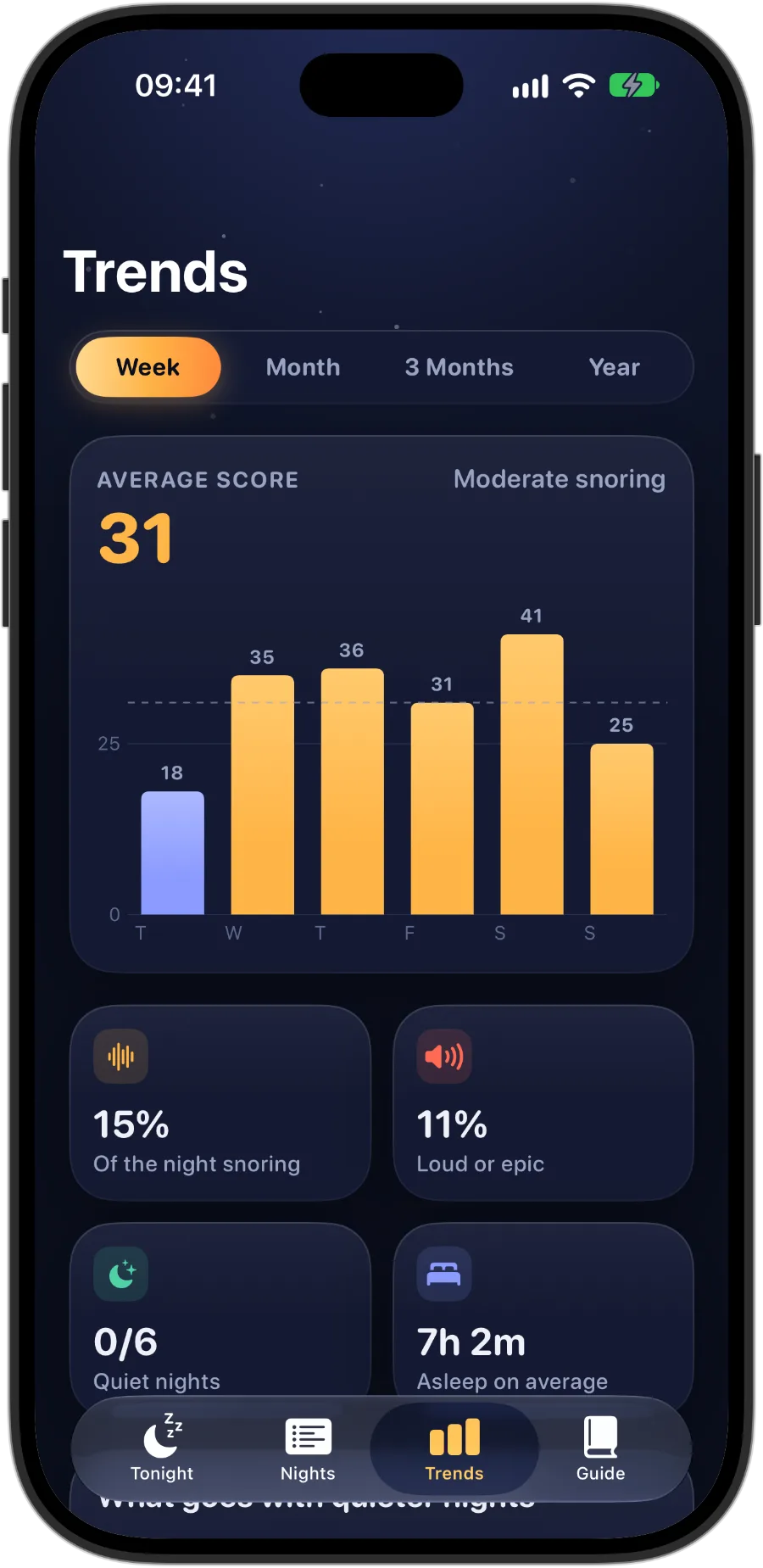
This page is general information, not medical advice. Snores is not a medical device and does not diagnose sleep apnea or any other condition. If you are worried about your sleep or your breathing, talk to a doctor.