ANSWERS
Does exercise help snoring?
Yes, it seems to, even before any weight comes off. Here's what the studies found.
Key study
Exercise training and sleep apnea
- 5 studies
- 129 adults
- Supervised training
Researchers pooled studies in which adults with obstructive sleep apnea took part in supervised exercise programs. Breathing events fell by 6.3 an hour on average, sleep efficiency rose by almost 6 percentage points, daytime sleepiness fell by 3.3 points and fitness improved, while body mass index barely changed.
A larger network meta-analysis of 80 trials compared treatments for sleep apnea: CPAP reduced breathing events the most, but exercise training also helped and significantly improved daytime sleepiness, so the authors suggested using it alongside other treatments 2.
Why it might help
Exercise may reduce fluid that builds up in the neck when lying down, improve the tone of breathing muscles and deepen sleep, and over time it helps with weight, which itself reduces snoring 3.
What kind of exercise
- Regular aerobic exercise, such as brisk walking, cycling or swimming, most days.
- Strength training, as part of a balanced routine.
- Daily mouth and throat exercises, which target the airway directly and reduced snoring in trials 4.
Does working out stop snoring?
It reduced sleep apnea severity in studies 1, and helps with weight, but it rarely stops snoring on its own.
What exercise is best for snoring?
Regular aerobic exercise plus daily mouth and throat exercises.
Does exercise help snoring without weight loss?
In sleep apnea studies, it helped with little change in weight 1.
Can exercising at night make snoring worse?
There's no good evidence it does, but hard exercise late at night can make it harder to fall asleep for some people.
Sources
- Iftikhar IH, Kline CE, Youngstedt SD. Effects of exercise training on sleep apnea: a meta-analysis. Lung. 2014;192(1):175-184. doi.org/10.1007/s00408-013-9511-3
- Iftikhar IH, Bittencourt L, Youngstedt SD, et al. Comparative efficacy of CPAP, MADs, exercise-training, and dietary weight loss for sleep apnea: a network meta-analysis. Sleep Med. 2017;30:7-14. doi.org/10.1016/j.sleep.2016.06.001
- Peppard PE, Young T, Palta M, Dempsey J, Skatrud J. Longitudinal study of moderate weight change and sleep-disordered breathing. JAMA. 2000;284(23):3015-3021. doi.org/10.1001/jama.284.23.3015
- Ieto V, Kayamori F, Montes MI, et al. Effects of oropharyngeal exercises on snoring: a randomized trial. Chest. 2015;148(3):683-691. doi.org/10.1378/chest.14-2953
COMING SOON
Snore less.
Find what works.
Snores measures your snoring every night, suggests which remedies to try, guides a few minutes of throat exercises a day and shows which changes go with quieter nights for you. The sound stays on your iPhone.
Meet Snores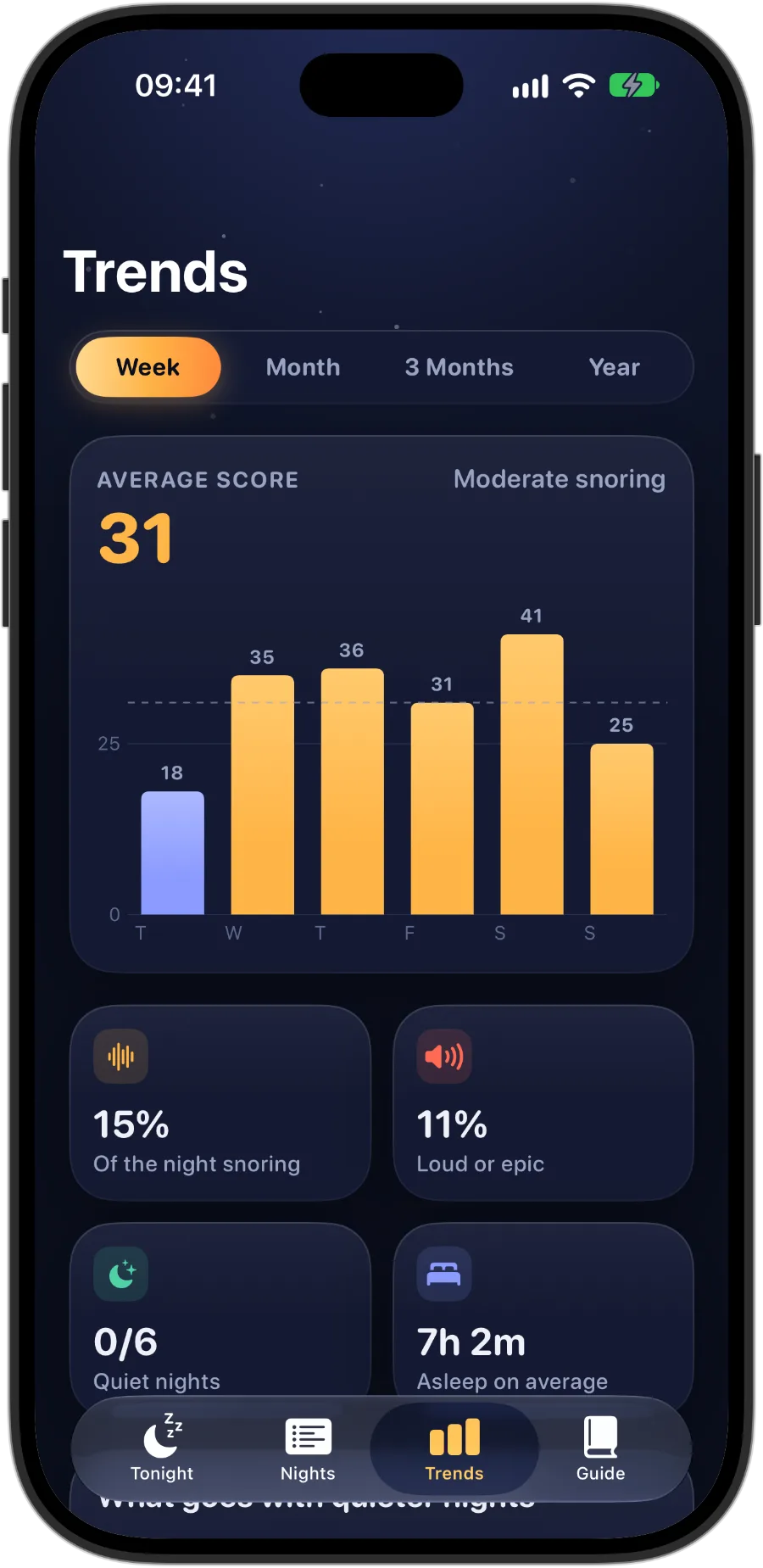
This page is general information, not medical advice. Snores is not a medical device and does not diagnose sleep apnea or any other condition. If you are worried about your sleep or your breathing, talk to a doctor.