SNORING
Foods and drinks that make you snore
Alcohol matters most. Here's what the evidence says about late meals, dairy and caffeine.
Drinks
| Drink | What we know | What to do |
|---|---|---|
| Alcohol | Relaxes the throat muscles; brought on breathing pauses in snorers in the first hour of sleep 1; higher intake linked with a 25% higher risk of sleep apnea 4 | Stop a few hours before bed, drink less, and compare nights |
| Coffee, tea and energy drinks | Heavy caffeine use went with regular snoring in a large survey 2; caffeine also delays and lightens sleep | Keep caffeine to the morning and early afternoon |
| Milk and dairy | No link with mucus or congestion in a controlled study 3 | No need to cut it out for snoring |
| Water | Thirst and a dry mouth often come from mouth breathing, not from snoring itself | Drink normally; treat the dry mouth's cause |
Key study
Does milk make mucus?
- 51 adults
- Infected with a common cold virus
- 10 days
Volunteers were given a cold virus and kept daily records of their milk and dairy intake and their symptoms, while their used tissues were weighed. They drank between none and 11 glasses of milk a day. Milk and dairy intake wasn't linked with more congestion or more nasal secretions. People who believed milk makes mucus reported more symptoms, but didn't produce more.
Meals
Many people find that a large, rich meal shortly before bed makes their sleep worse and their snoring louder, possibly through reflux, a full stomach pressing upwards, or simply sleeping more deeply on their back. There is little research on this specific effect, which makes it a good thing to test on your own nights rather than a rule.
- Finish your main meal two to three hours before bed if you can.
- Keep late snacks small.
- If you get heartburn at night, ask your doctor or pharmacist about it.
The long game: what you eat over months
What you eat matters most through your weight. A 10% weight loss went with a 26% drop in sleep apnea severity in a four-year study 5, and in heavy snorers, losing 3 kg or more nearly halved snores per hour 6. There is no anti-snoring superfood; any diet you can stick to that brings your weight down will do. See snoring and weight.
Myth Dairy makes you snore because it causes mucus.
Fact In a controlled study, milk and dairy intake didn't increase mucus or congestion 3.
Myth A nightcap helps you sleep, so it helps snoring.
Fact Alcohol may make you drowsy, but it relaxes the throat and makes snoring and breathing pauses worse 1.
Myth Certain foods melt away snoring.
Fact No food has been shown to stop snoring. Weight, alcohol and a clear nose matter far more.
What foods make you snore more?
Alcohol is the clearest culprit 1. Large late meals may make snoring worse for some people. Dairy hasn't been shown to 3.
Does dairy make you snore?
There's no good evidence. In a study of people with colds, milk didn't increase mucus or congestion 3.
Does eating late make you snore?
It may for some people, though research is thin. Finishing dinner two to three hours before bed is a simple thing to test.
Does caffeine make you snore?
Heavy caffeine use was linked with regular snoring in one large survey 2. It also makes sleep lighter, so keep it early in the day.
Sources
- Issa FG, Sullivan CE. Alcohol, snoring and sleep apnea. J Neurol Neurosurg Psychiatry. 1982;45(4):353-359. doi.org/10.1136/jnnp.45.4.353
- Ohayon MM, Guilleminault C, Priest RG, Caulet M. Snoring and breathing pauses during sleep: telephone interview survey of a United Kingdom population sample. BMJ. 1997;314(7084):860-863. doi.org/10.1136/bmj.314.7084.860
- Pinnock CB, Graham NM, Mylvaganam A, Douglas RM. Relationship between milk intake and mucus production in adult volunteers challenged with rhinovirus-2. Am Rev Respir Dis. 1990;141(2):352-356. doi.org/10.1164/ajrccm/141.2.352
- Simou E, Britton J, Leonardi-Bee J. Alcohol and the risk of sleep apnoea: a systematic review and meta-analysis. Sleep Med. 2018;42:38-46. doi.org/10.1016/j.sleep.2017.12.005
- Peppard PE, Young T, Palta M, Dempsey J, Skatrud J. Longitudinal study of moderate weight change and sleep-disordered breathing. JAMA. 2000;284(23):3015-3021. doi.org/10.1001/jama.284.23.3015
- Braver HM, Block AJ, Perri MG. Treatment for snoring: combined weight loss, sleeping on side, and nasal spray. Chest. 1995;107(5):1283-1288. doi.org/10.1378/chest.107.5.1283
COMING SOON
Snore less.
Find what works.
Snores measures your snoring every night, suggests which remedies to try, guides a few minutes of throat exercises a day and shows which changes go with quieter nights for you. The sound stays on your iPhone.
Meet Snores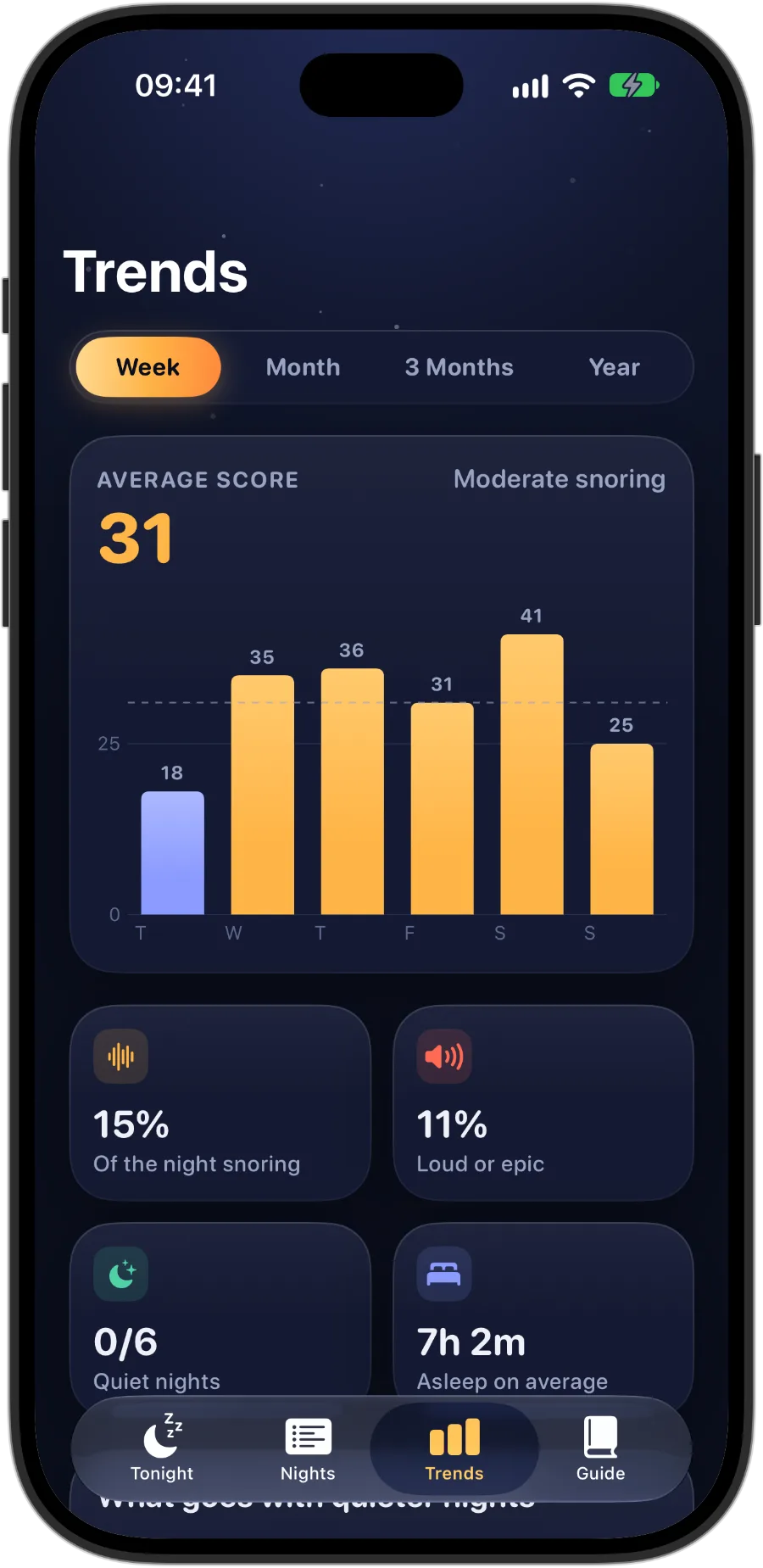
This page is general information, not medical advice. Snores is not a medical device and does not diagnose sleep apnea or any other condition. If you are worried about your sleep or your breathing, talk to a doctor.