
ANSWERS
Why do men snore more than women?
Men snore more often and more loudly, but the gap narrows with age, and women's snoring is often overlooked.
The numbers
Why the difference
- Where fat is stored. Men tend to carry more weight around the neck and upper body, which narrows the airway.
- Airway shape. Researchers think differences in the size and shape of the airway play a part.
- Hormones. Female hormones are thought to help keep the throat muscles toned, which is why snoring and sleep apnea rise in women after menopause 4,5.
- Habits. Men drink alcohol and smoke more on average, both linked with snoring 1,7.
Why do women start snoring after menopause?
Falling hormone levels are thought to make the throat muscles less toned; after menopause, sleep-disordered breathing becomes much more likely 4.
Do women snore as loudly as men?
On average, women snore less loudly 2, but some women snore very loudly.
Is snoring in women more dangerous?
Not necessarily, but sleep apnea in women is more often missed 8.
Sources
- Ohayon MM, Guilleminault C, Priest RG, Caulet M. Snoring and breathing pauses during sleep: telephone interview survey of a United Kingdom population sample. BMJ. 1997;314(7084):860-863. doi.org/10.1136/bmj.314.7084.860
- Wilson K, Stoohs RA, Mulrooney TF, et al. The snoring spectrum: acoustic assessment of snoring sound intensity in 1,139 individuals undergoing polysomnography. Chest. 1999;115(3):762-770. doi.org/10.1378/chest.115.3.762
- Young T, Palta M, Dempsey J, Skatrud J, Weber S, Badr S. The occurrence of sleep-disordered breathing among middle-aged adults. N Engl J Med. 1993;328(17):1230-1235. doi.org/10.1056/NEJM199304293281704
- Young T, Finn L, Austin D, Peterson A. Menopausal status and sleep-disordered breathing in the Wisconsin Sleep Cohort Study. Am J Respir Crit Care Med. 2003;167(9):1181-1185. doi.org/10.1164/rccm.200209-1055OC
- Bixler EO, Vgontzas AN, Lin HM, et al. Prevalence of sleep-disordered breathing in women: effects of gender. Am J Respir Crit Care Med. 2001;163(3):608-613. doi.org/10.1164/ajrccm.163.3.9911064
- Peppard PE, Young T, Barnet JH, et al. Increased prevalence of sleep-disordered breathing in adults. Am J Epidemiol. 2013;177(9):1006-1014. doi.org/10.1093/aje/kws342
- Wetter DW, Young TB, Bidwell TR, Badr MS, Palta M. Smoking as a risk factor for sleep-disordered breathing. Arch Intern Med. 1994;154(19):2219-2224. doi.org/10.1001/archinte.1994.00420190121014
- Young T, Evans L, Finn L, Palta M. Estimation of the clinically diagnosed proportion of sleep apnea syndrome in middle-aged men and women. Sleep. 1997;20(9):705-706. doi.org/10.1093/sleep/20.9.705
COMING SOON
Snore less.
Find what works.
Snores measures your snoring every night, suggests which remedies to try, guides a few minutes of throat exercises a day and shows which changes go with quieter nights for you. The sound stays on your iPhone.
Meet Snores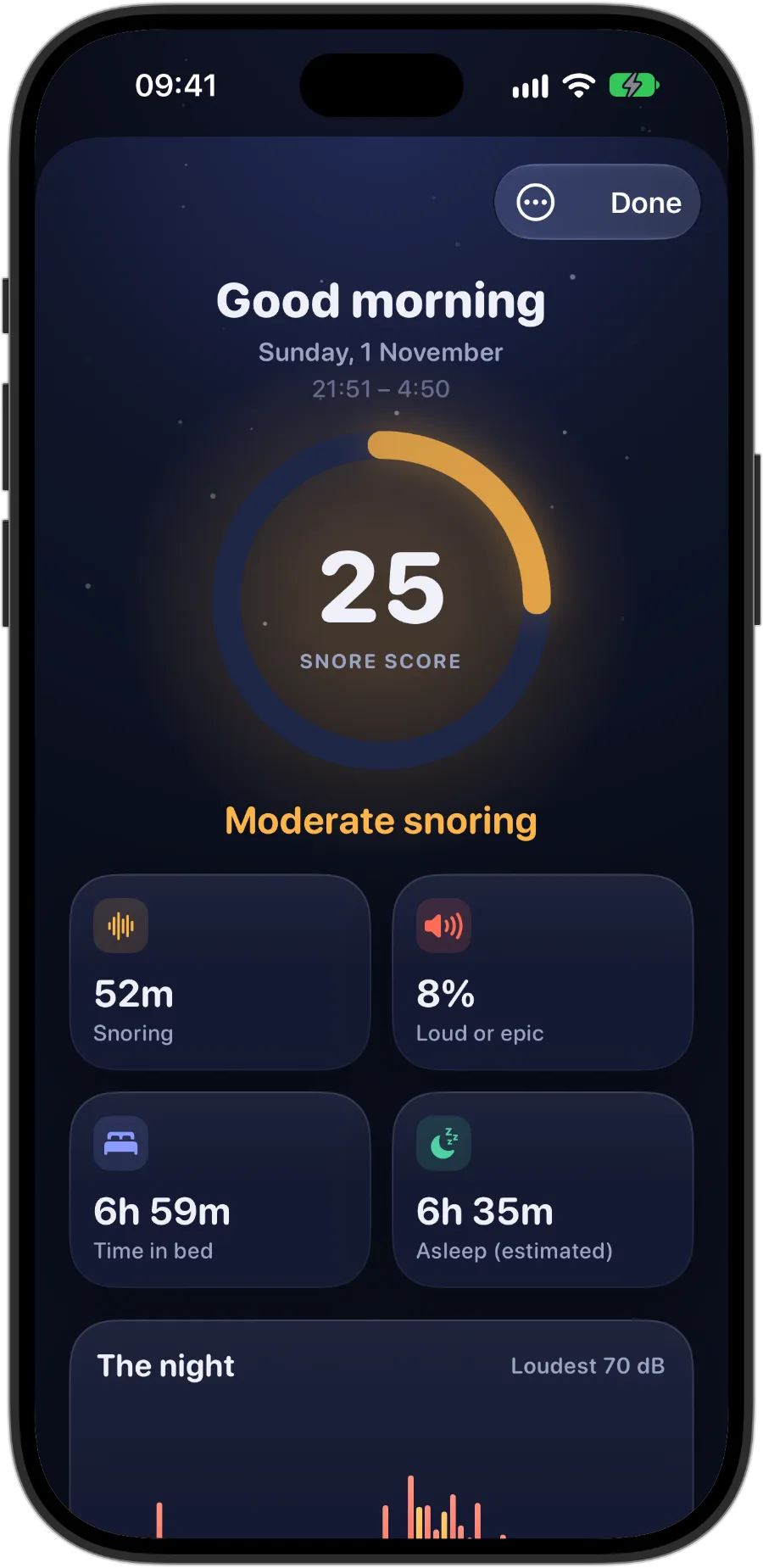
This page is general information, not medical advice. Snores is not a medical device and does not diagnose sleep apnea or any other condition. If you are worried about your sleep or your breathing, talk to a doctor.