
SNORING
Seasonal snoring: colds, allergies and dry air
If your snoring comes and goes with the seasons, your nose is the likely culprit. Here's how to get ahead of it.
Season by season
| Season | Usual trigger | What to try |
|---|---|---|
| Winter | Colds and flu; dry air from heating | Saline rinses, steam before bed, a humidifier, nasal strips |
| Spring | Tree and grass pollen | Allergy treatment early in the season, showering before bed, windows closed at night |
| Summer | Grass and weed pollen; heat; more evening drinks | The same, plus less alcohol late in the evening |
| Autumn | Mould spores and dust mites as heating starts | Wash bedding hot, keep the bedroom dust-free, ventilate |
Colds
A cold blocks the nose, so you breathe harder and through your mouth, and the snoring usually settles when the cold does. Saline sprays and steam can ease the congestion, nasal strips can open the nostrils, and sleeping on your side or slightly propped up helps. Decongestant sprays work quickly but shouldn't be used for more than a few days in a row.
Hay fever and allergies
Allergies are the most common reason for a nose that's blocked night after night. In a placebo-controlled trial in people with allergic rhinitis, a nasal steroid spray improved congestion and sleep 2. These sprays take several days to work, so starting before your usual season helps. Ask a pharmacist or doctor which treatment suits you. See a blocked nose and allergies.
Dry, heated air
Central heating can make the air dry enough to leave the nose and throat irritated in the morning. A humidifier or a bowl of water near a radiator may help comfort, although there is little research on whether it reduces snoring itself.
Why do I snore more in winter?
Colds, dry heated air and more time indoors with dust mites all make a blocked nose more likely, and a blocked nose makes snoring more likely 1.
Can hay fever make you snore?
Yes. Allergy-related congestion is linked with snoring and sleep-disordered breathing 1, and treating it can improve sleep 2.
How do I stop snoring with a cold?
Clear the nose with saline or steam, use a nasal strip, sleep on your side or slightly propped up, and skip alcohol. The snoring usually goes when the cold does.
Does an air purifier help snoring?
If dust or pet allergies block your nose, cleaner air may help. There is little research on purifiers and snoring itself.
Sources
- Young T, Finn L, Kim H. Nasal obstruction as a risk factor for sleep-disordered breathing. J Allergy Clin Immunol. 1997;99(2):S757-S762. doi.org/10.1016/S0091-6749(97)70124-6
- Craig TJ, Teets S, Lehman EB, Chinchilli VM, Zwillich C. Nasal congestion secondary to allergic rhinitis as a cause of sleep disturbance and daytime fatigue and the response to topical nasal corticosteroids. J Allergy Clin Immunol. 1998;101(5):633-637. doi.org/10.1016/S0091-6749(98)70171-X
- Löth S, Petruson B. Improved nasal breathing reduces snoring and morning tiredness: a 6-month follow-up study. Arch Otolaryngol Head Neck Surg. 1996;122(12):1337-1340. doi.org/10.1001/archotol.1996.01890240045010
COMING SOON
Snore less.
Find what works.
Snores measures your snoring every night, suggests which remedies to try, guides a few minutes of throat exercises a day and shows which changes go with quieter nights for you. The sound stays on your iPhone.
Meet Snores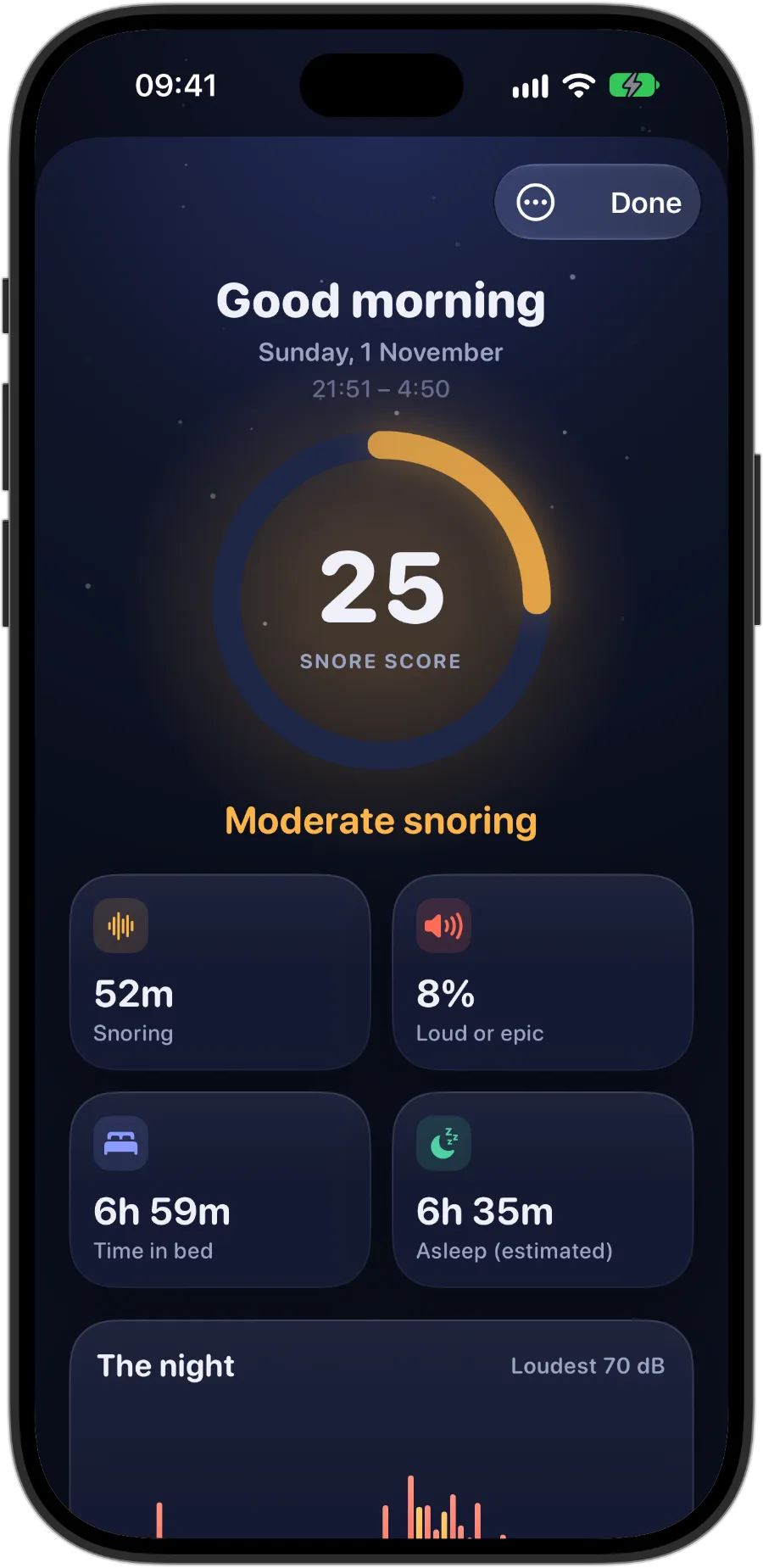
This page is general information, not medical advice. Snores is not a medical device and does not diagnose sleep apnea or any other condition. If you are worried about your sleep or your breathing, talk to a doctor.