ANSWERS
What is a good Snore Score?
Under 10 is a quiet night. But your trend, and what moves it, matters more than any single score.
| Score | Band | What it usually means |
|---|---|---|
| Under 10 | A quiet night | Little or no snoring |
| 10 to 24 | Light snoring | Some snoring, mostly soft or in short spells |
| 25 to 49 | Moderate snoring | Snoring for a fair part of the night, or loud for a shorter part |
| 50 to 74 | Loud snoring | Snoring for much of the night, often loudly |
| 75 and up | Epic snoring | Loud or epic snoring for most of the night |
How the score is worked out
Each second of snoring counts 1 point when light, 2 when loud and 3 when epic. The points are divided by the time listened and multiplied by 100, up to 100. Snoring lightly for a tenth of the night scores about 10; snoring loudly for a third of it, about 67. Try it in the Snore Score calculator.
Why your score changes
- Sleeping on your back or your side 2.
- Alcohol in the evening 3.
- A blocked nose, a cold or allergies 4.
- How tired you are, and how deeply you sleep 2.
- Other sounds that were counted as snoring, which you can mark as not snoring.
How to bring it down
Start with the changes that match your type of snoring, test one at a time, and watch your weekly average. The 30-day plan is a good structure.
What is a normal Snore Score?
Scores vary a lot between people and nights. Under 10 is a quiet night; many snorers sit in the light to moderate bands.
Is a Snore Score of 50 bad?
It means loud snoring for much of the night. It's worth trying remedies, and mentioning to a doctor if it comes with pauses or daytime sleepiness.
Why is my Snore Score so different every night?
Position, alcohol, your nose and sleep stages all change from night to night 1.
Is the Snore Score the same as in other apps?
No. Each app measures snoring its own way. Compare your Snores scores with each other, not with other apps.
Sources
- Pevernagie D, Aarts RM, De Meyer M. The acoustics of snoring. Sleep Med Rev. 2010;14(2):131-144. doi.org/10.1016/j.smrv.2009.06.002
- Nakano H, Ikeda T, Hayashi M, Ohshima E, Onizuka A. Effects of body position on snoring in apneic and nonapneic snorers. Sleep. 2003;26(2):169-172. doi.org/10.1093/sleep/26.2.169
- Issa FG, Sullivan CE. Alcohol, snoring and sleep apnea. J Neurol Neurosurg Psychiatry. 1982;45(4):353-359. doi.org/10.1136/jnnp.45.4.353
- Young T, Finn L, Kim H. Nasal obstruction as a risk factor for sleep-disordered breathing. J Allergy Clin Immunol. 1997;99(2):S757-S762. doi.org/10.1016/S0091-6749(97)70124-6
- Kapur VK, Auckley DH, Chowdhuri S, et al. Clinical practice guideline for diagnostic testing for adult obstructive sleep apnea: an American Academy of Sleep Medicine clinical practice guideline. J Clin Sleep Med. 2017;13(3):479-504. doi.org/10.5664/jcsm.6506
COMING SOON
Snore less.
Find what works.
Snores measures your snoring every night, suggests which remedies to try, guides a few minutes of throat exercises a day and shows which changes go with quieter nights for you. The sound stays on your iPhone.
Meet Snores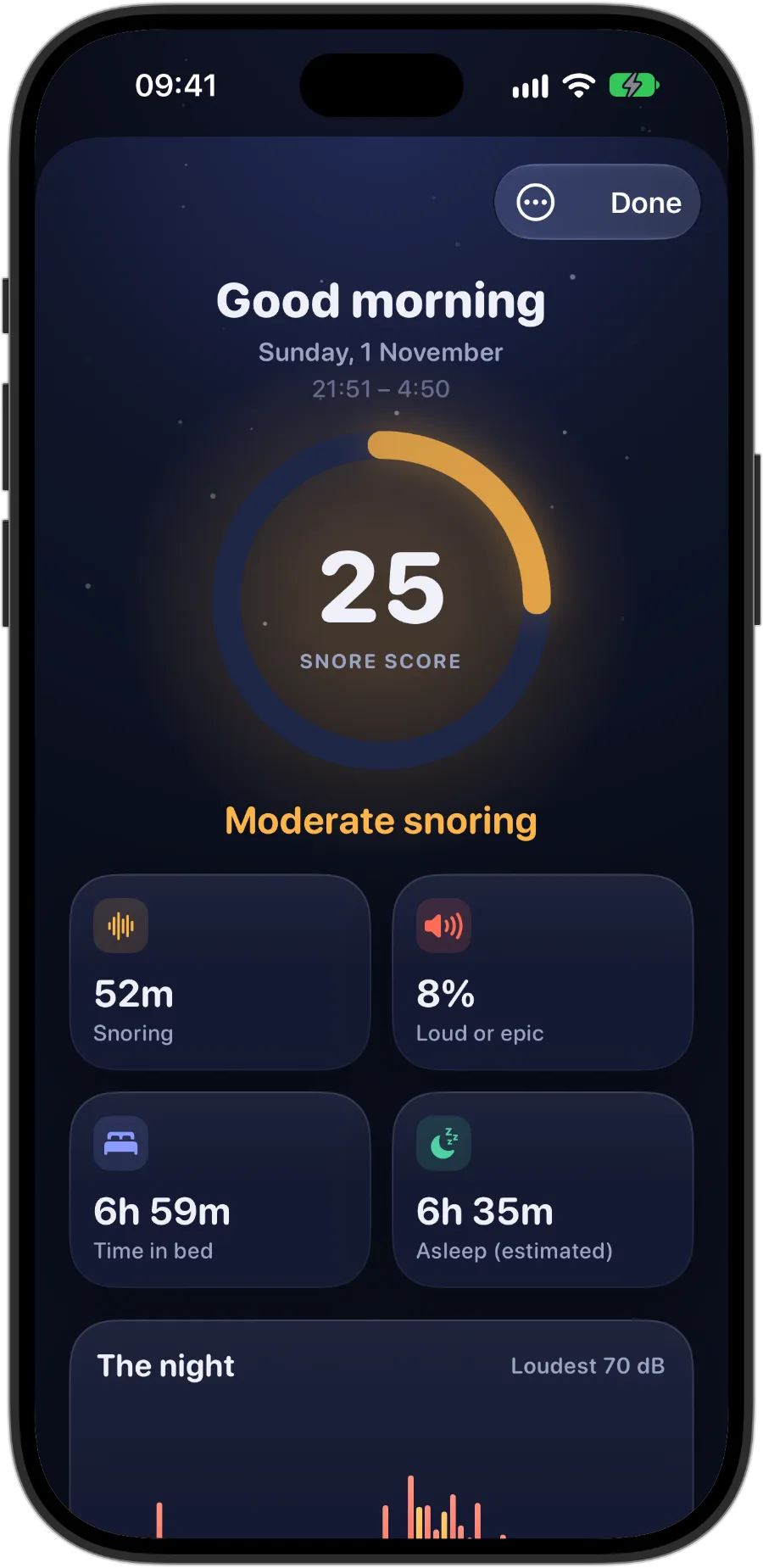
This page is general information, not medical advice. Snores is not a medical device and does not diagnose sleep apnea or any other condition. If you are worried about your sleep or your breathing, talk to a doctor.