ANSWERS
How loud is snoring?
From a soft purr to as loud as a conversation, and why loudness matters.
What the measurements show
In the largest study of snoring loudness, researchers measured the snoring of 1,139 people during sleep studies. They looked at the levels exceeded for 10% of the night: 12.3% of people snored louder than 55 dBA at that level. Snoring was louder in men than in women, and louder snoring went with more breathing disturbances, more daytime sleepiness and more reported breathing pauses. Men with obesity whose average snoring was louder than 38 dBA were four times more likely to have significant sleep-disordered breathing 1.
| Level | What it sounds like |
|---|---|
| About 30 dB | A whisper, or a very quiet bedroom |
| About 40 dB | A quiet library, or soft snoring |
| About 50 dB | Light rain, a quiet conversation, or moderate snoring |
| About 60 dB | Normal conversation, or loud snoring |
| About 70 dB | A vacuum cleaner a few metres away |
Why loudness matters
Loud snoring disturbs a partner more and is more often a sign of sleep apnea 1,2. But for a partner, it isn't only the peaks: in one study, partners' awakenings weren't triggered by the loudest moments, but ongoing snoring kept them awake longer 3.
How many decibels is loud snoring?
Loud snoring can exceed 55 to 60 dB, about the level of a normal conversation. In one study, 12% of people snored above 55 dBA for at least a tenth of the night 1.
Is loud snoring a sign of sleep apnea?
It can be. Louder snoring went with more breathing disturbances 1, and loud snoring makes moderate sleep apnea more likely 2. Pauses and gasping are the key signs.
Why is my partner's snoring so loud to me?
You are close to the source, and sound is much louder close up. Ongoing snoring also makes it harder to fall back asleep 3.
Can a phone measure snoring decibels?
Roughly. Phone microphones aren't calibrated sound meters, so readings are best used to compare your own nights rather than as exact levels.
Sources
- Wilson K, Stoohs RA, Mulrooney TF, et al. The snoring spectrum: acoustic assessment of snoring sound intensity in 1,139 individuals undergoing polysomnography. Chest. 1999;115(3):762-770. doi.org/10.1378/chest.115.3.762
- Young T, Shahar E, Nieto FJ, et al. Predictors of sleep-disordered breathing in community-dwelling adults: the Sleep Heart Health Study. Arch Intern Med. 2002;162(8):893-900. doi.org/10.1001/archinte.162.8.893
- Blumen MB, Quera Salva MA, Vaugier I, et al. Is snoring intensity responsible for the sleep partner's poor quality of sleep? Sleep Breath. 2012;16(3):903-907. doi.org/10.1007/s11325-011-0554-5
COMING SOON
Find out
how you snore.
Snores listens through the night on your iPhone and shows you in the morning how much and how loudly you snored, with clips of the loudest moments. Tag what you tried and see what goes with quieter nights. The sound stays on your iPhone.
Meet Snores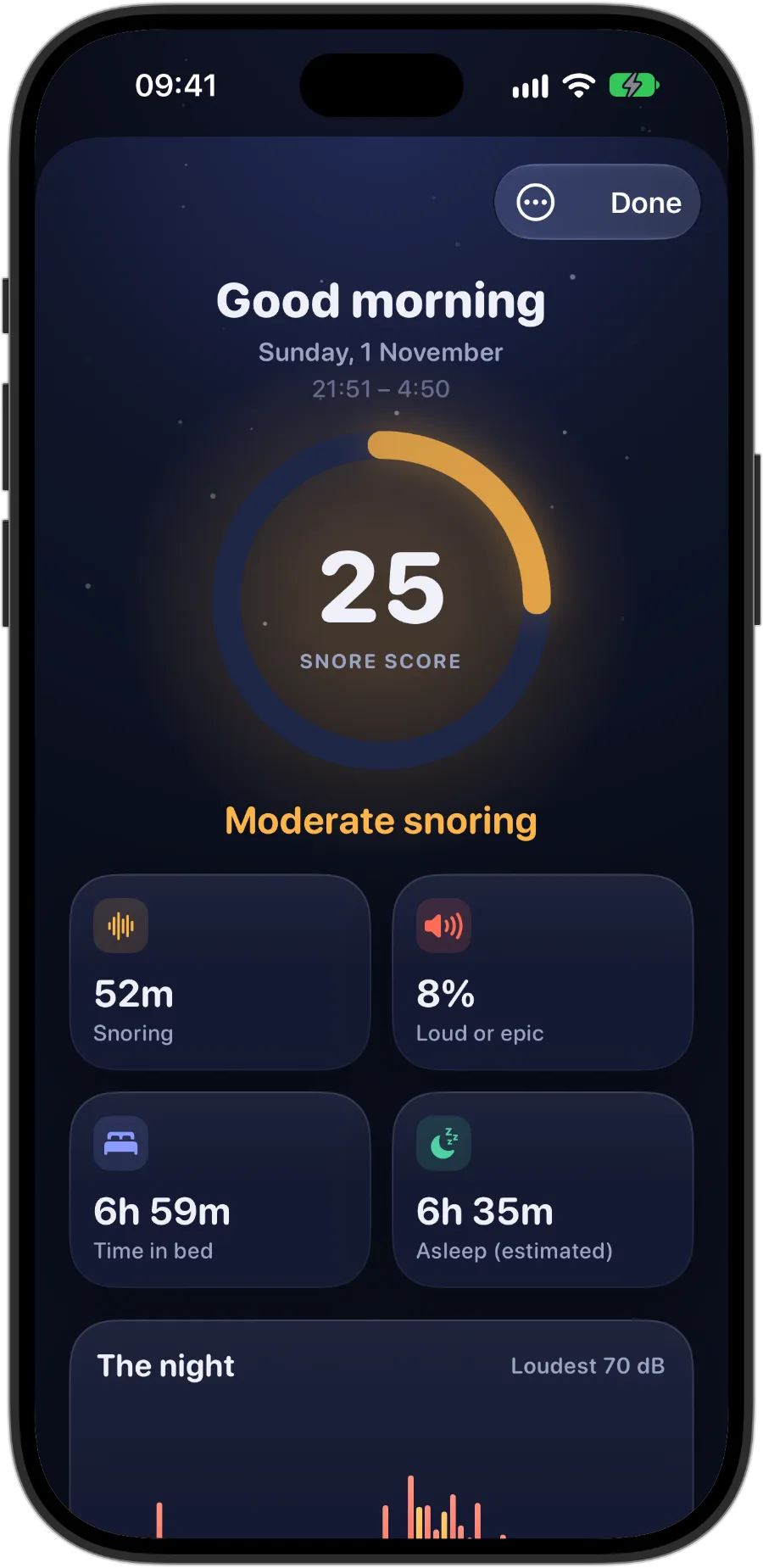
This page is general information, not medical advice. Snores is not a medical device and does not diagnose sleep apnea or any other condition. If you are worried about your sleep or your breathing, talk to a doctor.